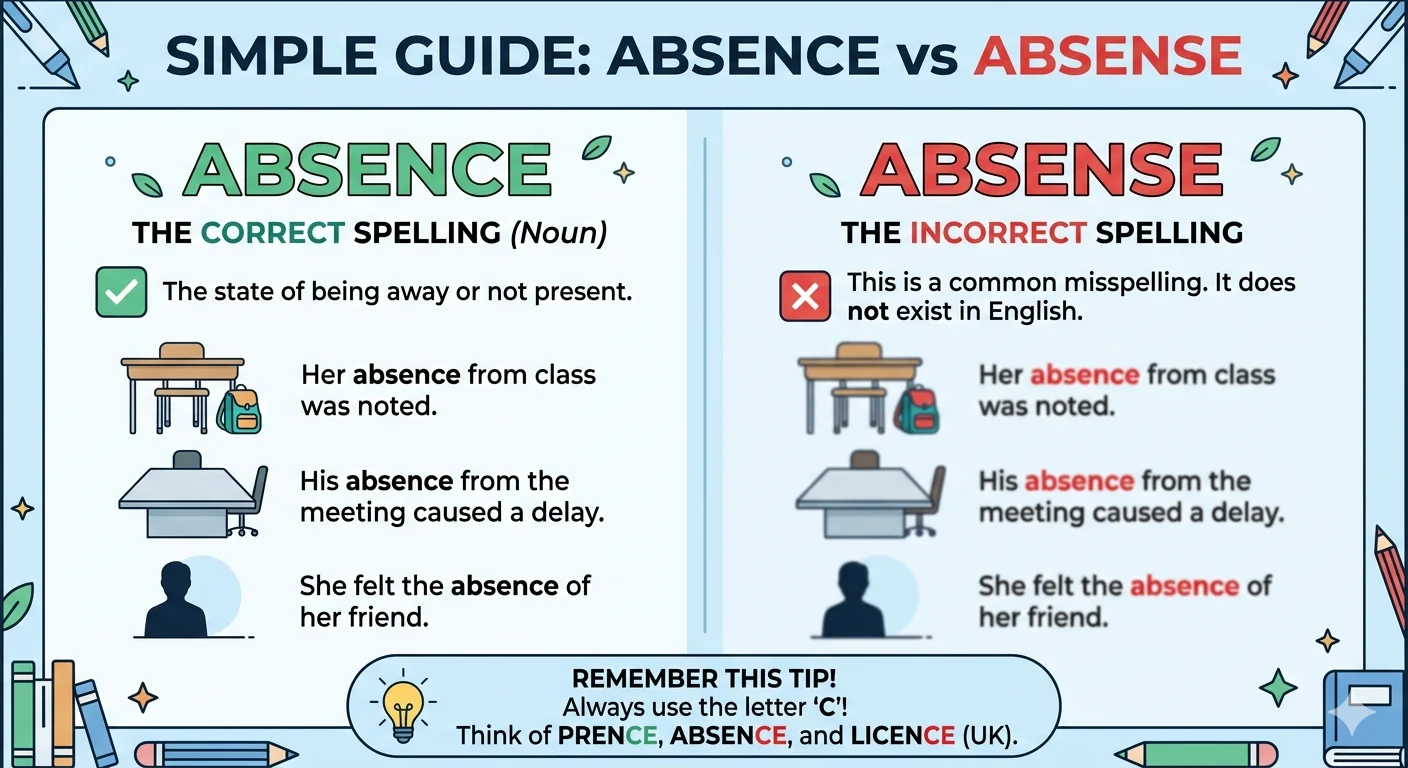
Is it “absence” or “absense”? If you have ever typed this word and stared at the screen, second-guessing yourself, you are not alone. Many people search for this keyword because the correct spelling is not immediately obvious.The pronunciation often makes it sound like it should contain an “s,” leading to the common misspelling “absense.”
This article solves that confusion once and for all. We will explore the difference between absence or absense, provide the quick answer you need, and dive into the history of the word.
Whether you are writing a school note, a work email, or trying to improve your grammar, understanding is it absence or absense is a small but important step toward mastery of English.
Absence or Absense means
The quick answer is: the correct spelling is “absence” (with a ‘c’). “Absense” (with an ‘s’) is always a spelling mistake.
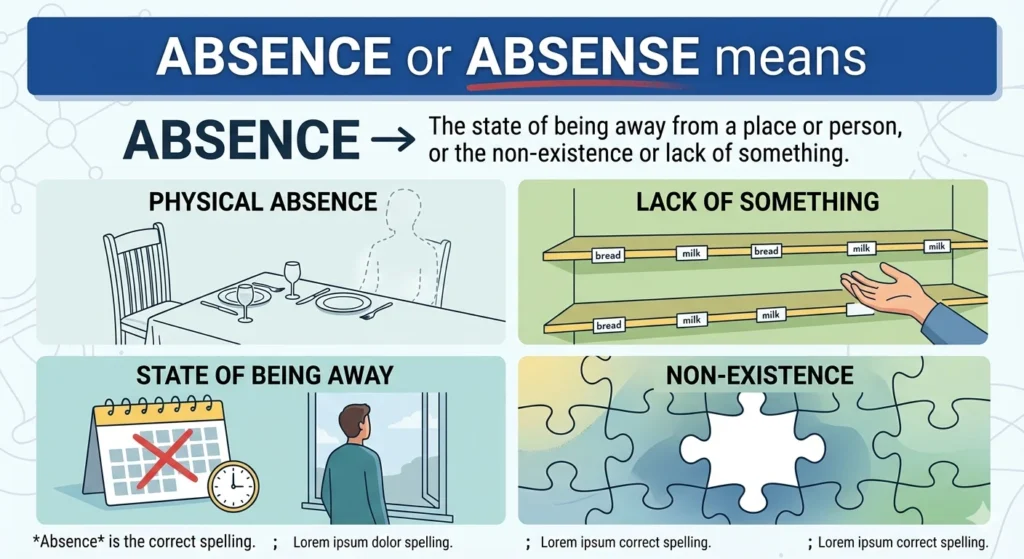
The word is a noun that means being away from a place, or the state of something not existing .
Examples of correct usage:
- Your absence from the meeting was noted.
- The case was dismissed in the absence of proof.
- She took a leave of absence from work .
Incorrect usage:
- ~~Your absense from the meeting was noted.~~ (Incorrect spelling)
The Origin of Absence
To understand why absence is spelled with a ‘c’, we have to look at its history. The word entered the English language in the 14th century. It came from Old French, which borrowed it from the Latin word absentia . The Latin root abesse means “to be away from” .
The spelling confusion usually happens because of how we pronounce it. In phonetics, the word is often rendered as /ˈæb səns /, which can trick the brain into thinking it ends with an “-ense” sound, like the word “sense” . However, the etymological root confirms the correct spelling is with a ‘c’, not an ‘s’. This answers the question, is absence a correct spelling?—Yes, and it is the only correct spelling based on its linguistic heritage.
British English vs American English Spelling
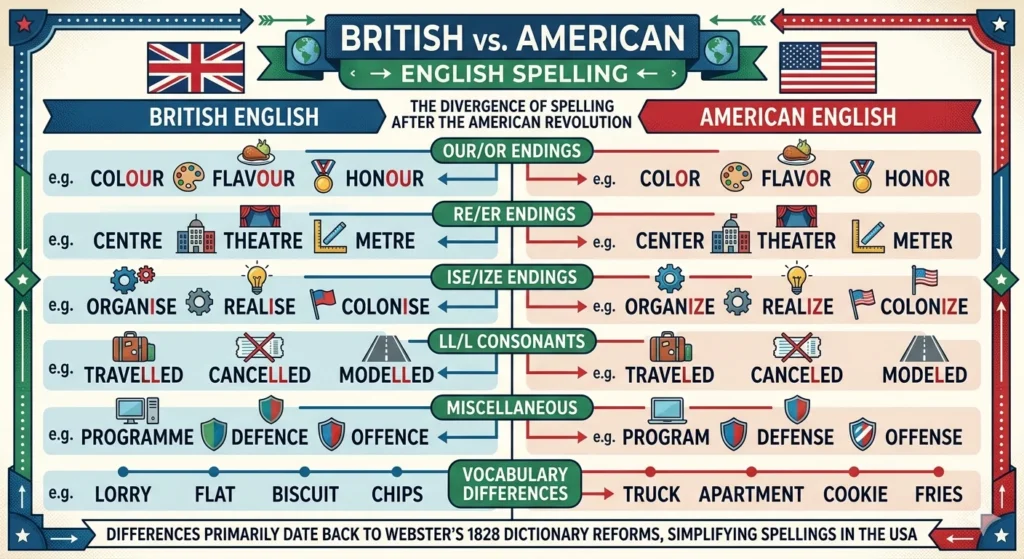
One of the most common questions regarding absence or absense in english is whether the spelling changes between countries. Fortunately, this is one of the easier rules in English.
Unlike words such as “color” (US) vs. “colour” (UK), or “realize” (US) vs. “realise” (UK), the spelling of “absence” remains constant. Whether you are in London, New York, or Sydney, the spelling is always absence.
When people search for absence or absense uk, they are often worried that the UK might use a different variation. They do not. The correct spelling in British English is “absence,” just as it is in American English.
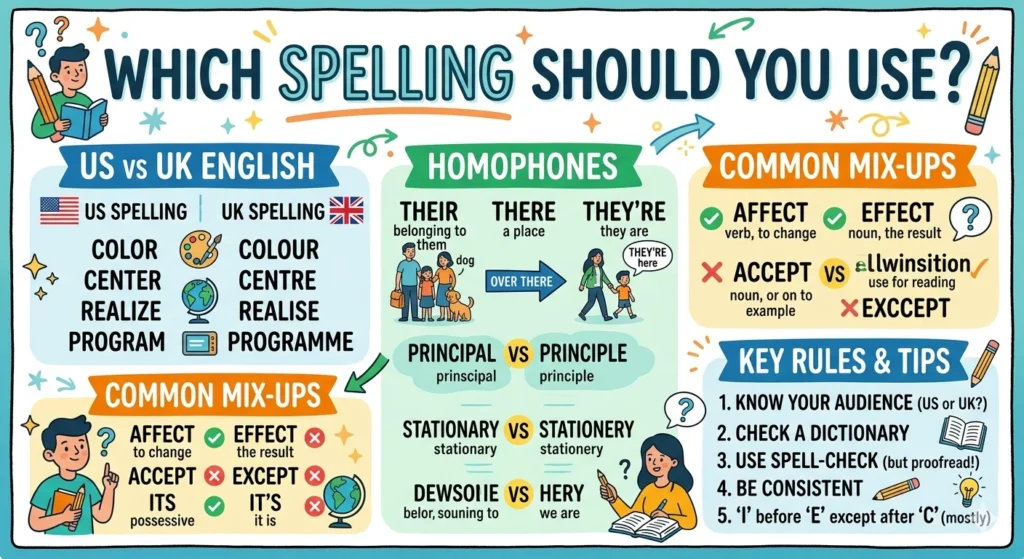
Which Spelling Should You Use?
Since the spelling does not change based on geography, the rule is simple: always use absence.
- If you are in the US: Use absence. (e.g., His absence was unexcused).
- If you are in the UK or Commonwealth: Use absence. (e.g., She was notable by her absence).
- If you are writing for a global audience: Use absence. It is universally understood as correct.
If you are ever unsure about how do you spell absence in the UK?, remember that there is no difference. The word is standardized across all major English-speaking regions.
Common Mistakes with Absence
The confusion between absence or absense leads to several frequent errors. Here are the most common misspellings and how to fix them:
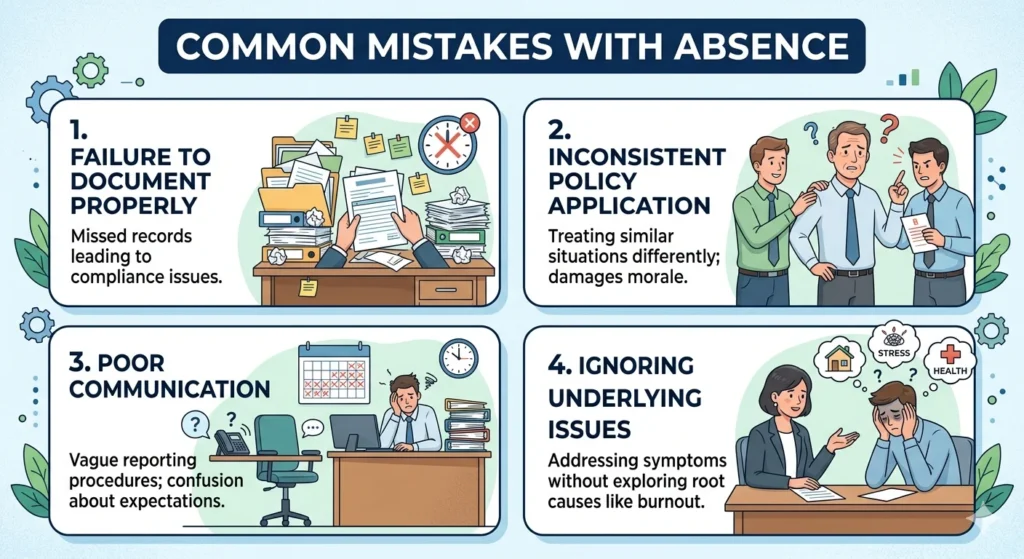
- Absense (The most common mistake): People replace the ‘c’ with an ‘s’ because of the soft ‘c’ sound.
- Correction: Change the ‘s’ to a ‘c’ -> Absence.
- Abscence: People sometimes transpose the letters, trying to force the ‘s’ and ‘c’ into a different order .
- Correction: Remember the order is A-B-S-E-N-C-E.
- Absance: Mistaking the vowel at the end.
A useful trick to remember the spelling is to note that while the word doesn’t make much “sense” (which is spelled with an ‘s’), it requires a ‘c’ in the middle .
Absence in Everyday Examples
Seeing the word used correctly in context helps solidify the difference between absence or absense meaning. Here is how it looks in real life:
- Formal Writing (Academic/Business): “The professor noted the student’s frequent absence.”
- News Headlines: Recent data shows a surge in “sickness absence” in the UK due to heatwaves and burnout .
- Emails: “In my absence, please direct all inquiries to my assistant.”
- Social Media: “An absence of likes on that post made him sad.”
- Legal/Medical Terms: The term is often used in medical contexts, such as “absence of oxygen” or “absence seizures” (a type of short seizure) . It is also used in legal settings like “leave of absence” .
Absence Google Trends & Usage Data

While the spelling doesn’t change geographically, the topics related to absence do trend differently. According to search data, the term “sickness absence” sees massive spikes in usage depending on current events. For example, in July 2024, the UK saw a 113% surge in searches for “sickness absence” during a heatwave .
This data shows that while people search for what is the difference between absence and absence (usually seeking spelling clarification), they also search for the term in practical contexts like work, school, and health. The word is highly relevant in HR departments, schools, and medical settings globally, reinforcing the need to spell it correctly in professional environments .
FAQs
Here are answers to the most common questions regarding is it spelled absence or absense?
1. How do you spell absence in the UK?
You spell it absence. There is no UK-specific variation; it is the same as in American English .
2. What is the meaning of absense?
“Absense” is not a word in the English dictionary. It is a common misspelling of the word absence, which means the state of being away or the lack of something .
3. What is the difference between absence and absence?
There is no difference because “absence” is the only correct spelling. The other variation does not exist in standard English. The question usually compares the correct spelling against a common misspelling.
4. Is absence a correct spelling?
Yes, absence is the only correct spelling. It is a noun that can be traced back to the Latin word absentia .
5. What is an absence medical term?
In medical terms, “absence” can refer to a type of seizure (formerly known as “petit mal”) where the patient appears to be staring into space and is unresponsive for a short period. It refers to an absence of responsiveness .
6. What is a good synonym for absence?
Depending on the context, synonyms include “lack,” “nonattendance,” “truancy,” “leave,” or “default” .
7. Why do people misspell absence as absense?
People misspell it because of pronunciation. The word is spoken with a soft ‘c’ that sounds like an ‘s’, leading people to write “absense” .
8. Is it “leave of absence” or “leave of absense”?
It is “leave of absence.” This is a common phrase used to describe a period of time off from work .
Conclusion
In the debate of absence or absense, the winner is clear. Absence is the historically accurate, grammatically correct, and universally accepted spelling. Whether you are asking is it absence or absense for a school report or a professional email, remember that “absense” is simply a mistake caused by the tricky nature of English pronunciation.
To summarize: use absence (with a ‘c’) for all contexts—whether you are referring to a person’s location, a lack of something, or a medical condition. Avoid the common trap of writing “absense,” and your writing will be cleaner and more professional. Keep practicing, and soon the correct spelling will feel as natural as the word itself.

“John Galsworthy was a refined storyteller known for expressive, emotional writing. At Wishveb.com, he brings graceful, heartfelt wishes to readers.”