Do you ever stop and wonder: should I say “she sings beautiful” or “she sings beautifully”? If so, you are not alone.
The question of adverb or adjective is one of the most common grammar puzzles. People search for this because they want to write clearly and sound professional. Getting it wrong can make your message look sloppy.
The confusion happens because both word types describe things. But they do it in different ways. This article will solve that problem for good. You will learn the quick rule, the history behind the words, and how to use them correctly in any setting.
By the end, you will know the difference between an adverb and an adjective without second-guessing yourself. Let us start with the simple answer you need right now.
Adverb or Adjective means
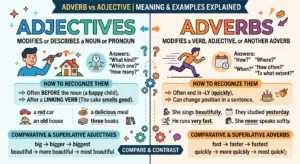
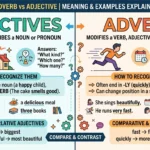
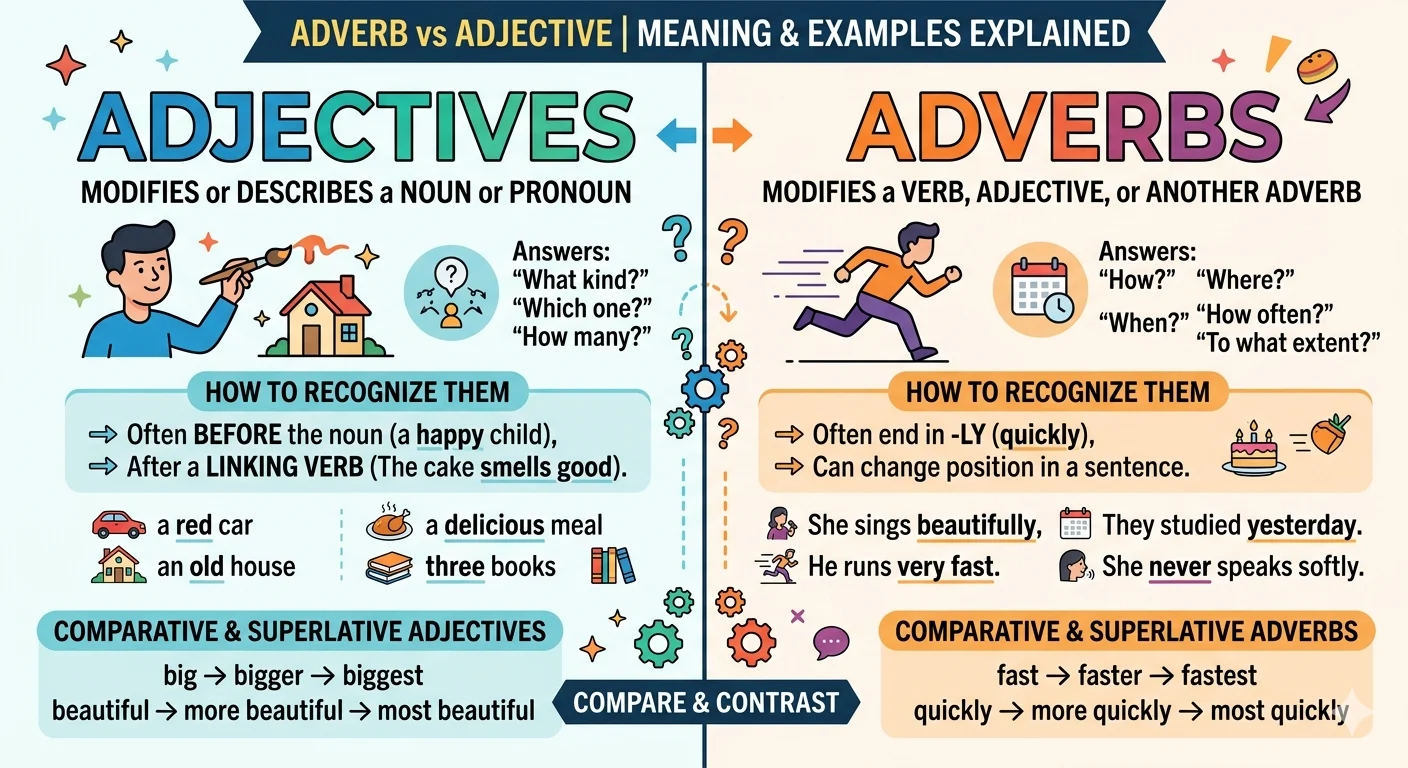
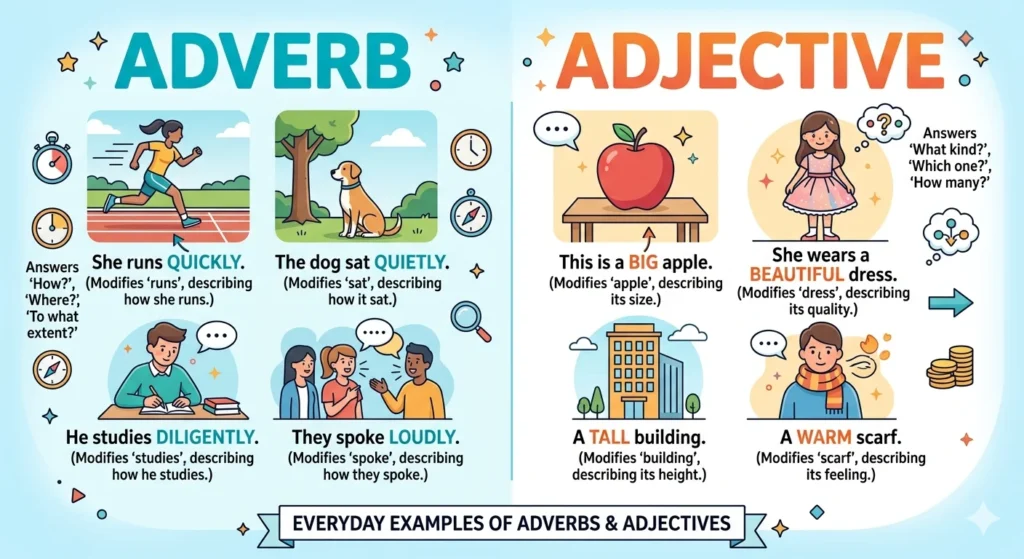
An adjective describes a noun (person, place, or thing). An adverb describes a verb, adjective, or another adverb. It often ends in “-ly.”
- Adjective example: She is a quick runner. (Quick describes runner.)
- Adverb example: She runs quickly. (Quickly describes how she runs.)
What is an adverb and adjective with example?
An adjective answers “what kind?” An adverb answers “how,” “when,” or “where.”
For instance: happy (adjective) child. The child laughed happily (adverb).
What are 10 examples of adverbs?
Quickly, slowly, always, never, very, too, yesterday, outside, almost, just.
What are 20 examples of adjectives?
Happy, sad, big, small, red, tall, short, bright, dark, loud, quiet, soft, hard, funny, lively, lonely, early, late, fast, slow.
What are 10 adjectives to adverb?
Quick → quickly, happy → happily, easy → easily, slow → slowly, careful → carefully, loud → loudly, soft → softly, angry → angrily, beautiful → beautifully, fast → fast (same form).
The Origin of Adverb or Adjective
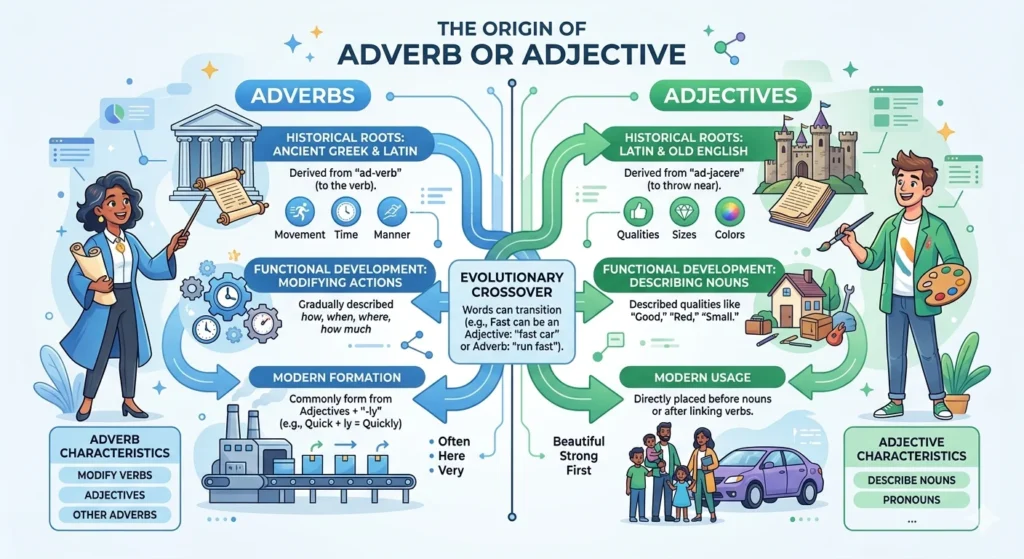
The words “adjective” and “adverb” come from Latin. “Adjective” comes from adiectivus, meaning “added to.” “Adverb” comes from adverbium, meaning “added to the verb.” This shows their original job: adjectives add to nouns, and adverbs add to verbs.
Spelling differences in English grew over time. Old English had complex endings for word types. After the Norman Conquest in 1066, French and Latin rules mixed with Germanic roots. This is why some adverbs do not end in “-ly,” like fast or hard. It is also why some words can be both an adverb or adjective, like early, late, and only. The history explains why English has so many exceptions.
British English vs American English Spelling
When it comes to adverb or adjective, the spelling rules are mostly the same in both British and American English. However, there is one key difference in how adverbs are formed from adjectives ending in “-ic.”
| Word Type | British English | American English |
|---|---|---|
| Adverb from “basic” | basically | basically (same) |
| Adverb from “public” | publically (rare) | publicly |
| Adverb from “dramatic” | dramatically | dramatically |
| Adjective “color” | colour | color |
| Adverb “colorfully” | colourfully | colorfully |
The main difference lies in the base adjective spelling (colour vs color). Once you add “-ly” to make an adverb, the rule follows the same pattern. For clarity, both versions are accepted globally.
Which Spelling Should You Use?
Your choice depends on your audience.
- United States: Use American English. Colorfully, publicly, lovely (adjective).
- United Kingdom & Commonwealth: Use British English. Colourfully, publically (though “publicly” is common), lovely (adjective).
- Global Audience: Pick one style and stay consistent. American English is more common in digital content, but British English is preferred in many international schools and exams.
Remember: the adverb or adjective rule is the same. The only change is spelling in a few base words. If you are writing for a test like IELTS, follow British English. For a US business, use American English.
Common Mistakes with Adverb or Adjective
- Using an adjective instead of an adverb after a verb.
❌ She sings beautiful.
✅ She sings beautifully. - Using an adverb with a linking verb.
❌ The food tastes badly.
✅ The food tastes bad. (Taste is a linking verb; it takes an adjective.) - Confusing good and well.
❌ She did good on the test.
✅ She did well on the test. (Well is an adverb.)
✅ She is a good student. (Good is an adjective.) - Misplacing only.
❌ I only ate vegetables. (Meaning: I only ate them; I did not cook them.)
✅ I ate only vegetables. (Meaning: Vegetables were the only thing I ate.) - Using real instead of really.
❌ That is real nice.
✅ That is really nice.
Adverb or adjective sentences to compare:
- He is a hard worker. (adjective)
- He works hard. (adverb)
- She arrived late. (adverb)
- She was late for the meeting. (adjective)
Adverb or Adjective in Everyday Examples
Emails:
- Thank you for your quick response. (adjective)
- You responded quickly. (adverb)
News:
- The rapid growth surprised economists. (adjective)
- The economy grew rapidly. (adverb)
Social Media:
- This is a funny video. (adjective)
- He laughed funny. (adverb – informal, but accepted)
Formal Writing:
- The study provides clear evidence. (adjective)
- The study clearly demonstrates the effect. (adverb)
Adverb or adjective for kids can be taught with simple sentences:
- The slow turtle. (adjective)
- The turtle walks slowly. (adverb)
Adverb or Adjective Google Trends & Usage Data
According to Google Trends, the search “adverb or adjective” is most popular in the United States, India, and the Philippines. Searches spike during back-to-school months (August–September) and before major English exams like the SAT, IELTS, and TOEFL.
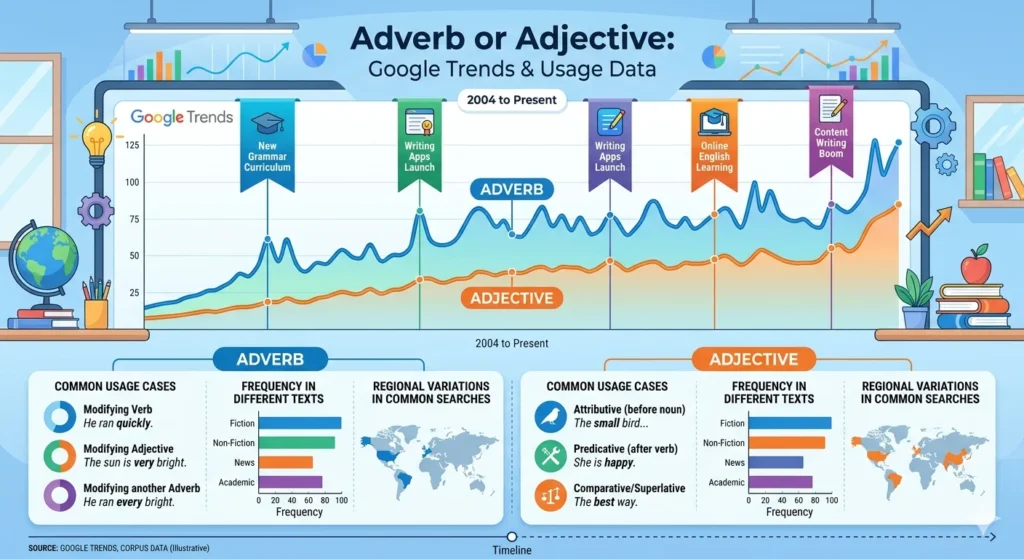
The most common individual searches include:
- is very an adverb or adjective – Very is usually an adverb.
- is quickly an adverb or adjective – Quickly is always an adverb.
- is outside an adverb or adjective – Outside can be both.
- is funny an adverb or adjective – Funny is always an adjective.
- is yesterday an adverb or adjective – Yesterday can be both.
- is early an adverb or adjective – Early can be both.
- is hard an adverb or adjective – Hard can be both.
Comparison Table: Adverb or Adjective?
| Word | As an Adjective | As an Adverb |
|---|---|---|
| fast | A fast car | Drive fast |
| hard | A hard test | Work hard |
| early | An early train | Arrive early |
| late | A late dinner | Sleep late |
| only | The only reason | I only asked |
| just | A just decision | I just arrived |
| never | – (not used) | I never go |
| very | – (not used) | Very good |
| lively | A lively party | – (rarely used as adverb) |
| lonely | A lonely person | – (not used as adverb) |
FAQs
1. Is very an adverb or adjective?
Very is always an adverb. It modifies adjectives or other adverbs. Example: very fast.
2. Is quickly an adverb or adjective?
Quickly is always an adverb. It describes how an action is done. Example: She ran quickly.
3. Is outside an adverb or adjective?
Outside can be both. Adjective: the outside door. Adverb: He went outside.
4. Is funny an adverb or adjective?
Funny is always an adjective. The adverb form is funnily. Example: He spoke funnily.
5. Is hard an adverb or adjective?
Hard can be both. Adjective: a hard question. Adverb: She tried hard.
6. Is lively an adverb or adjective?
Lively is always an adjective. There is no common adverb form. Use “in a lively way.”
7. What are 10 sentences with adverbs and adjectives?
- The quick fox runs fast.
- She is a happy child who laughs loudly.
- That was a hard test. I studied hard.
- He gave a slow smile and walked slowly away.
- The early bird arrives early.
- It is a real problem, and it is really serious.
- She is a good singer. She sings well.
- The loud music played loudly.
- He is a careful driver. He drives carefully.
- That was a sudden move. It happened suddenly.
8. Where can I find an adverb or adjective worksheet?
Many free worksheets are available online. Search for “adverb or adjective worksheet PDF” on education sites like K5 Learning or Grammarly.
Conclusion
The difference between an adverb or adjective is simple. Adjectives describe nouns. Adverbs describe verbs, adjectives, or other adverbs. Most adverbs end in “-ly,” but not all. Some words, like fast, hard, early, and late, can be both.
If you want to write clearly, remember this trick: after a linking verb (is, are, feels, tastes), use an adjective. After an action verb, use an adverb. Check your sentences by asking: what is being described? If it is a person or thing, use an adjective. If it is an action, use an adverb.
For a quick reference, keep a list of common words like adverb or adjective list handy. Use the adverb or adjective worksheet to practice. Whether you are writing for school, work, or social media, getting this right makes you look professional and confident.

“Laurence Sterne was a creative, expressive writer known for his unique style. At Wishveb.com, he adds charm and warmth to heartfelt wishes.”