Have you ever stumbled upon the word “comptroller” and wondered if it was a typo? You are not alone.
Thousands of people search for “comptroller or controller” every month, trying to figure out if they are the same thing, which spelling is correct, or if one is a more prestigious job title.
This confusion is valid because, despite the fancy extra letters, “comptroller” is pronounced exactly like “controller.” The search often stems from someone reading a job description, seeing a government official in the news, or writing a resume and wanting to use the proper term.
This article solves that confusion by explaining the historical origins of the word, the specific contexts where each spelling is used, and the very real differences in the jobs themselves, especially when comparing controller vs CFO or comptroller vs controller vs treasurer roles.
Comptroller or Controller means
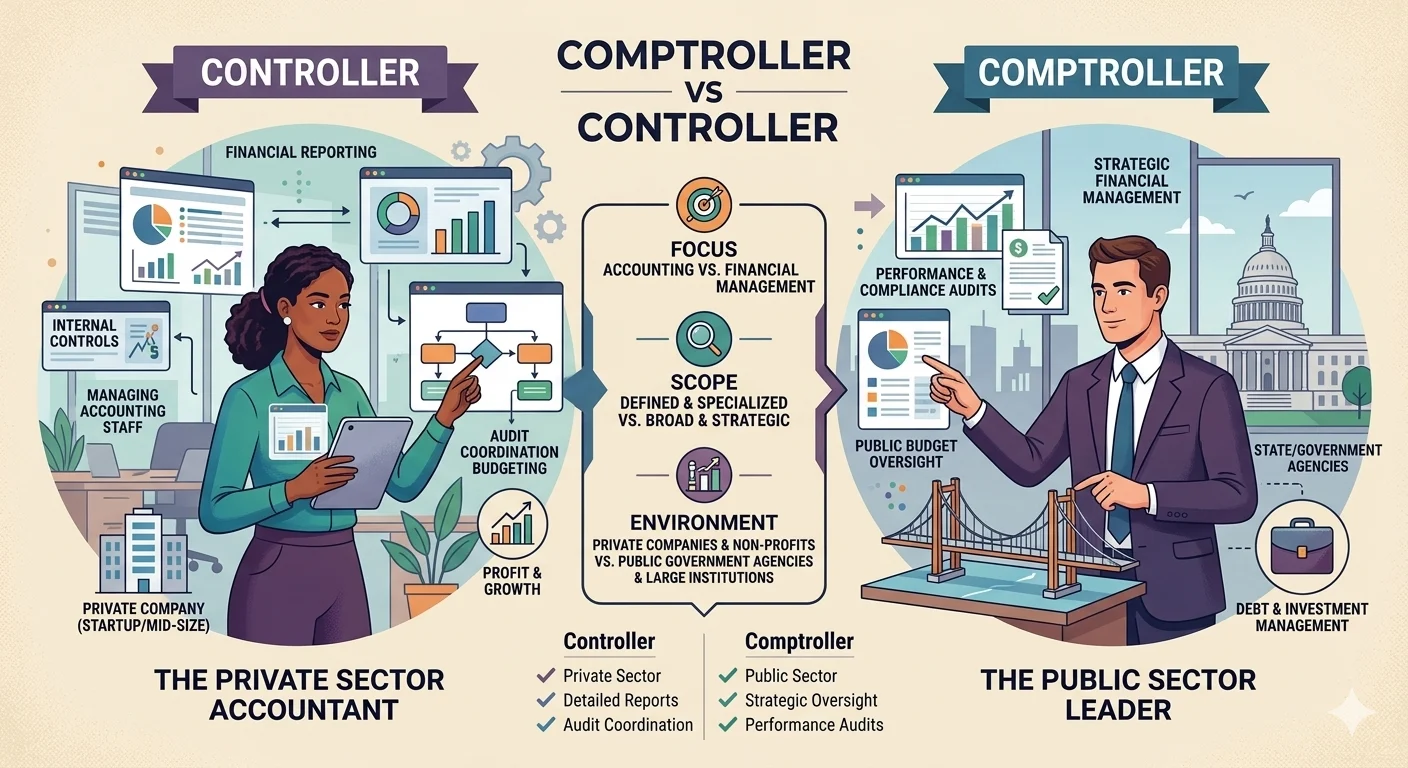
So, which one is it? The quick answer is that both words describe the same primary job function: the person responsible for the accounting operations of an organization. The difference is almost entirely based on where they work.
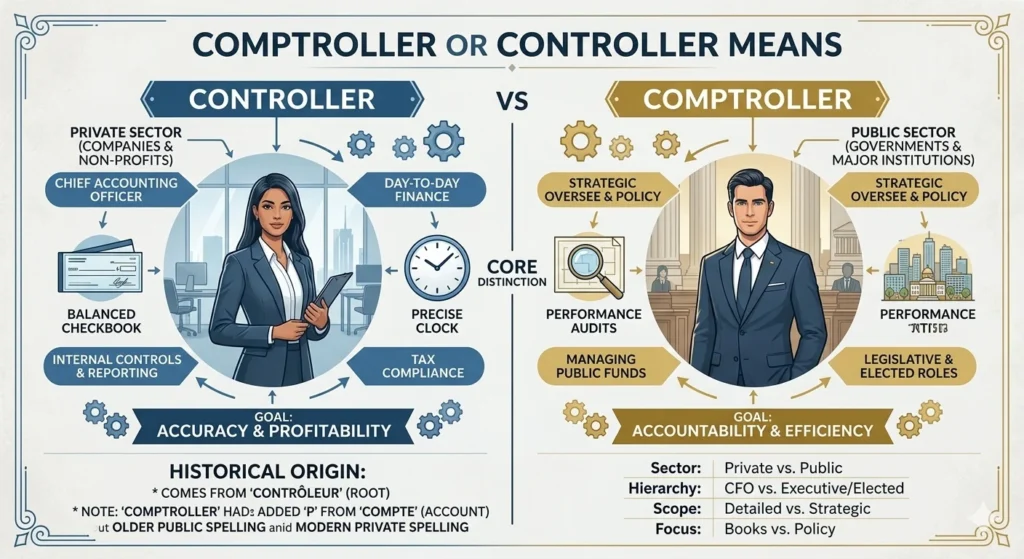
- Controller is the standard spelling used in for-profit businesses, corporations, and private companies. If you work at a tech startup or a manufacturing plant, the head of accounting is likely called the Controller.
- Comptroller is a historical variant of the same word, used almost exclusively in government, non-profit organizations, and public sectors. For example, a city government will likely have a City Comptroller.
While the spelling changes, the pronunciation does not. In both cases, you say “controller.”
The Origin of Comptroller
To understand why this confusing spelling exists, we have to look at the word’s etymology. The word is a blend of two linguistic influences.
- The French Influence: The word “count” (as in counting money) comes from the Old French word conte, meaning “account.”
- The Latin Influence: The word “controller” comes from the Medieval Latin word contrarotulus, which was a “counter-roll” or a duplicate copy of a scroll used to verify accounts.
During the 15th century, a linguistic mix-up occurred. The “cont-” part of “controller” became associated with the French compte (“an account”). As a result, the spelling began to change to “comptroller” to reflect this connection to accounting, even though the pronunciation remained the same. It was a way to make the title look more official and connected to counting finances, distinguishing it from the common word “control,” which had slightly different connotations.
British English vs American English Spelling
While the “comptroller” spelling exists on both sides of the Atlantic, its usage follows a similar pattern, though government structures differ.
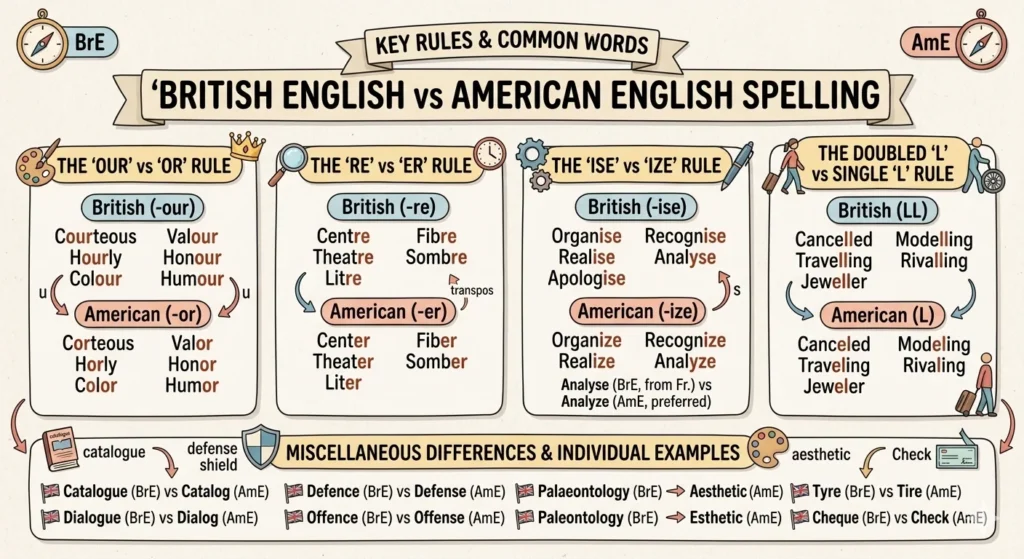
- American English: “Controller” is the dominant spelling for private industry. “Comptroller” is reserved for specific government roles, such as the Comptroller of the Currency (a federal office) or various State Comptrollers (like the New York State Comptroller).
- British English / Commonwealth: The same rule applies. Private companies have “Financial Controllers.” However, the “comptroller” spelling is retained for very senior public roles, most notably the Comptroller and Auditor General, who heads the National Audit Office. It is also used in royal household titles, such as the Comptroller of the Household.
Here is a simple comparison table:
| Feature | Controller | Comptroller |
|---|---|---|
| Primary Context | For-profit businesses, Corporations | Government, Non-profits, Public Sector |
| Pronunciation | /kənˈtroʊ.lər/ (kuhn-TROH-ler) | /kənˈtroʊ.lər/ (kuhn-TROH-ler)* |
| Geographic Usage | Global (standard in business) | Global (specific to public offices) |
| Focus | Profitability, Cost Control, Reporting | Budget Compliance, Fund Accounting, Public Funds |
| Reporting To | CFO, CEO, or Board of Directors | Government Officials, Taxpayers, City Council |
Note: While the phonetic pronunciation is listed, some individuals in government may pronounce the ‘p’ in comptroller to distinguish the role, though this is not the historical standard.
Which Spelling Should You Use?
Choosing between comptroller or controller depends entirely on your audience and the type of organization you are writing about or working for.
- For a US or Global Business Audience: Always use Controller. Using “comptroller” in a corporate context will look old-fashioned or incorrect. If you are writing a job description for a manufacturing company, you should title it “Controller.”
- For a US Government or Non-Profit Audience: Use Comptroller. If you are referring to an official at the Government Accountability Office (GAO) or a State Auditor, “Comptroller” is the formal and respectful title.
- For a UK/Commonwealth Public Sector Audience: Use Comptroller for the specific statutory roles mentioned earlier. For general business, stick with “Financial Controller.”
Pros and Cons of Each Path
If you are planning your career, understanding the strengths and weaknesses of each sector can help you decide whether to aim for a controller or comptroller role.

Controller (Private Sector)
- Pros:
- Higher Earning Potential: Salaries are often higher, especially with stock options or bonuses in successful companies.
- Faster Growth: Promotions can come quickly in growing companies.
- Dynamic Environment: You work in a fast-paced setting with new challenges.
- Cons:
- Less Job Security: You can be laid off during downturns or company sales.
- Higher Stress: The pressure to meet profit goals can be intense.
- Longer Hours: Busy seasons often mean working evenings and weekends.
Comptroller (Public Sector / Non-Profit)
- Pros:
- High Job Security: Government jobs are very stable and rarely eliminated.
- Excellent Benefits: Pensions, health insurance, and time off are usually better.
- Work-Life Balance: Hours are generally more predictable and regular.
- Cons:
- Lower Salary: Pay is often capped and increases slowly.
- Bureaucracy: Decision-making is slow, and there is lots of red tape.
- Public Scrutiny: Your work is public record and can be criticized by anyone.
Common Mistakes with Comptroller or Controller
People encounter several pitfalls with these terms, ranging from pronunciation to job confusion.
- Mistake 1: Pronouncing the ‘P’. The most common error is saying “comp-troller.” The correct pronunciation ignores the ‘p’ entirely, sounding exactly like “controller.”
- Mistake 2: Thinking They Are Different Jobs. While the context differs, the core function of managing financial records, reporting, and internal controls is identical. A Controller at a factory and a Comptroller at a city hall perform essentially the same accounting duties.
- Mistake 3: Confusing Salary Expectations. People often wonder about comptroller or controller salary differences. Generally, a Controller in a large private corporation may earn a higher base salary and bonuses, while a Comptroller in government may have a lower salary but better job security and pension benefits. According to industry data, the median salary for a Controller (Financial Manager) is around $127,990, but this can vary wildly by sector.
- Mistake 4: Confusing the Role with a CFO. This is a frequent mix-up when discussing controller vs CFO. A Controller is focused on the past and present—ensuring the numbers are accurate. A CFO (Chief Financial Officer) is focused on the future—using those numbers for strategy, fundraising, and forecasting.
Comptroller or Controller in Everyday Examples
Seeing these words in context helps solidify when to use which spelling.
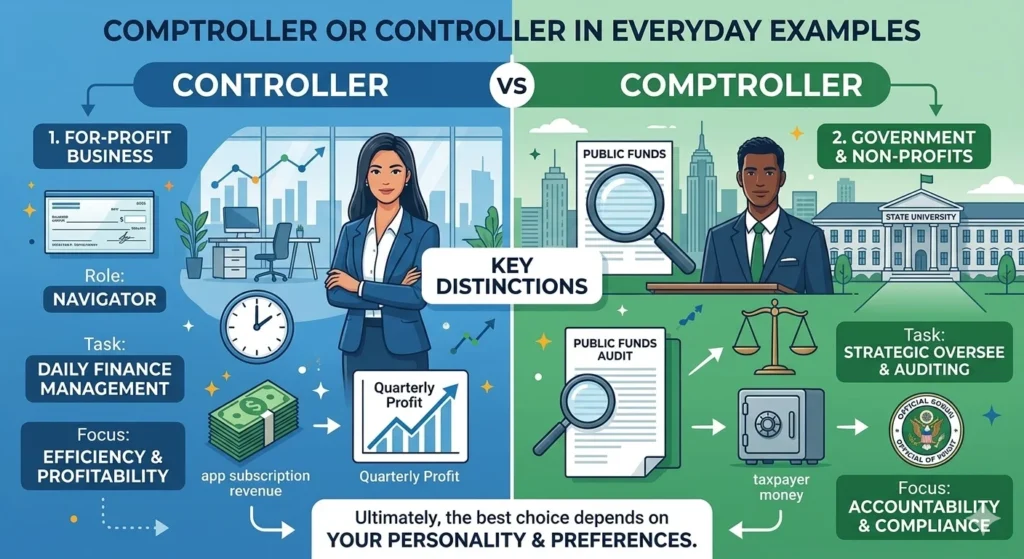
- In an Email (Corporate): “Hi Team, please send the Q3 reports to the Controller for review before the audit.”
- In a News Headline (Government): “City Comptroller releases annual financial audit, citing budget surpluses.”
- On Social Media (Career Advice): “Thinking about making the jump from comptroller in the public sector to controller in a private firm. Anyone made the switch?”
- In a Formal Job Description (Non-Profit): “The Comptroller will oversee all accounting operations, manage grant funds, and ensure compliance with donor restrictions.”
- In a Financial Comparison: “When looking at controller vs comptroller vs treasurer, remember the treasurer usually handles financing and investments, while the controller/comptroller handles recording transactions.”
Comptroller or Controller Google Trends & Usage Data
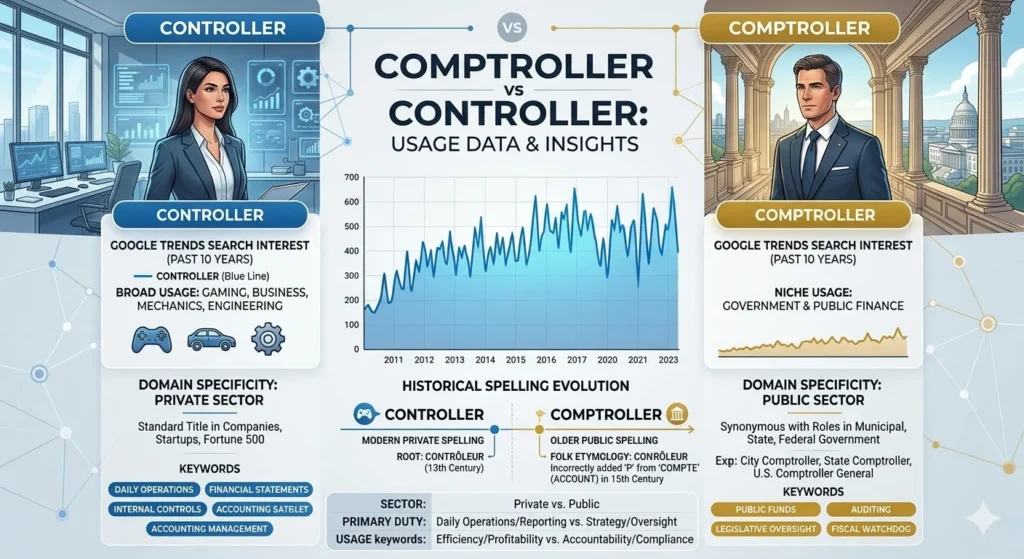
Data shows that the term “controller” is overwhelmingly more popular in global search, simply because the private sector employs far more people than the public sector. However, “comptroller” maintains strong search volume in specific regions with large state governments, such as New York, Illinois, Connecticut, and Texas, where “comptroller” is a prominent elected or appointed office.
Searches for phrases like “comptroller vs controller salary” spike when people are considering moving between public and private sectors. Meanwhile, searches for “comptroller pronunciation” remain consistently high, proving that the silent ‘p’ continues to baffle English speakers everywhere.
Keyword Comparison Table
| Keyword | Search Intent | Typical User |
|---|---|---|
| comptroller or controller | Informational / Clarification | Students, Job Seekers |
| comptroller vs controller salary | Commercial / Comparison | Employees considering a sector switch |
| controller vs CFO | Informational | Business Owners, Finance Students |
| comptroller pronunciation | Quick Question | General Public, News Readers |
| comptroller etymology | Deep Dive | Word enthusiasts, History buffs |
| is it comptroller or controller | Transactional / Clarification | Resume writers, Copy editors |
FAQs
1. Is a comptroller higher than a controller?
In terms of hierarchy, they are generally the same level—the head of accounting. However, in a government setting, a Comptroller might have a broader scope due to public accountability, sometimes acting as both the CFO and Controller for the public body.
2. Why is comptroller pronounced “controller”?
Because the word is a historical blend of Middle English (controller) and Old French (compte). The spelling changed to reflect the connection to “counting” accounts, but the pronunciation stuck with the original “controller.”
3. What is the difference between a controller and a treasurer?
The Controller (or Comptroller) is responsible for recording transactions, paying bills, and financial reporting (the “scorekeeping”). The Treasurer is responsible for managing cash, investments, debt, and funding (the “money managing”). In some organizations, these roles combine into a single “controller vs comptroller vs treasurer” figure, but in larger ones they are separate.
4. Do I need a CPA to be a Controller or Comptroller?
While not always mandatory, a Certified Public Accountant (CPA) designation is highly preferred for both roles. It is considered the gold standard for proving expertise in accounting and compliance.
5. Can a controller become a CFO?
Yes. The role of Controller is a common stepping stone to Chief Financial Officer. It provides the deep technical knowledge of a company’s finances needed to eventually take on the strategic role of a CFO.
6. Which spelling should I use on my resume?
Use the spelling that matches the industry you are applying to. If you are applying to a corporation, use “Controller.” If you are applying for a government job that specifically uses the title, use “Comptroller.” Using the wrong one might make it look like you don’t understand the industry context.
7. What is the average comptroller or controller salary?
The salary varies widely by location and company size. According to the U.S. Bureau of Labor Statistics, financial managers (a category that includes controllers) earn a median salary of around $130,000 per year, though this can range from $90,000 to well over $250,000 depending on experience and industry.
Conclusion
In the end, the debate between comptroller or controller is more about context than function. If you are dealing with a business, use controller. If you are dealing with the government or a non-profit, comptroller is likely the official term. Remember that despite the extra letters, they are pronounced the same and share the core responsibility of safeguarding an organization’s financial records. Whether you are researching comptroller vs controller salary data or trying to understand the hierarchy of controller vs CFO, knowing the context is the key to getting it right. Use the spelling that fits your audience, pronounce it correctly (silent ‘p’!), and you will sound like a true finance professional.

“Laurence Sterne was a creative, expressive writer known for his unique style. At Wishveb.com, he adds charm and warmth to heartfelt wishes.”