In today’s fast-paced business world, you hear these two words constantly: digitize and digitalize. They sound almost the same, and people often use them like they mean the exact thing. But if you are planning a big project, updating your business, or just trying to sound smart in a meeting, using the wrong word can make you look confused.
You are searching for this keyword because you have seen both spellings, you are unsure if there is a difference, and you want to get it right. The confusion is real—even big companies mix them up. This article solves that problem. We will break down the simple meaning of each word, look at where they came from, and settle the spelling debate between American and British English once and for all. By the end, you will know exactly which word to use and when.
Digitize or Digitalize means
Here is the simplest way to tell the difference:
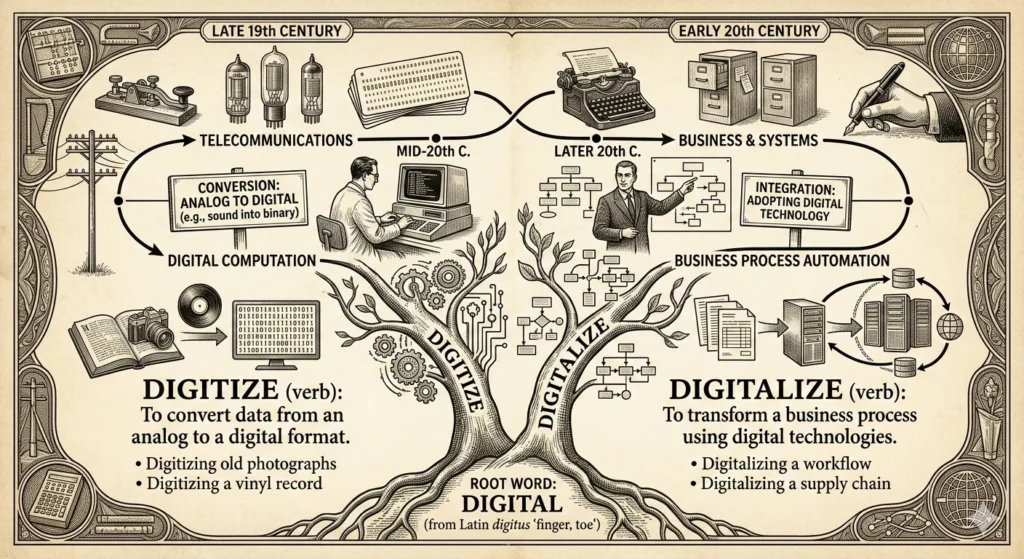
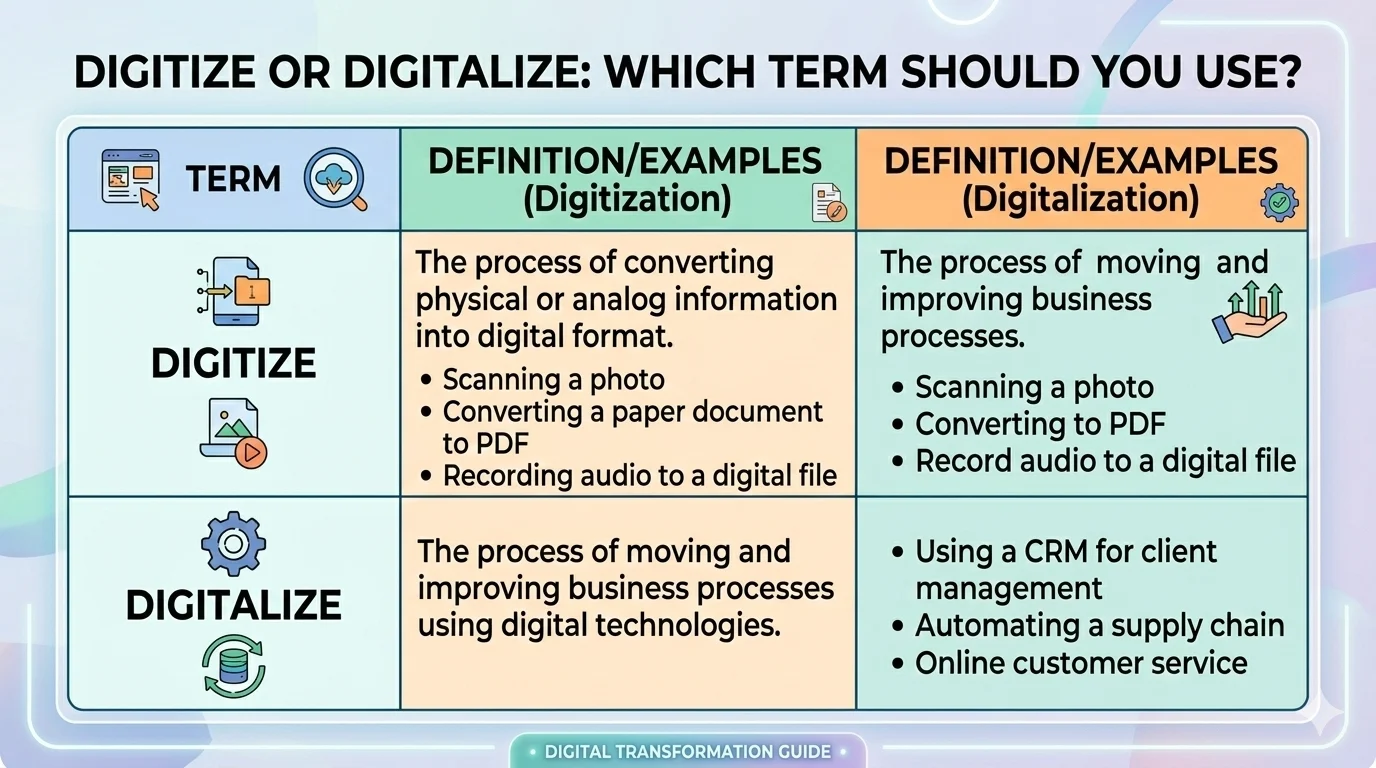
- Digitize means to change something physical (like a paper photo, a handwritten letter, or a vinyl record) into a digital format (like a JPEG, a PDF, or an MP3). It is about converting data.
- Example: Scanning old family photos to save them on your computer is digitizing them.
- Digitalize means to change a process or a whole business by using digital technologies. It is about improving how work gets done.
- Example: A bakery that starts using an online system for customers to order cakes instead of just taking orders over the phone is digitalizing their ordering process.
Can a company be digitized but not digitalized?
Yes, absolutely. A company can scan all its paper files to a computer (digitized), but if they still manage those files with the same old manual methods, they have not digitalized. Digitalization changes the workflow itself.
The Origin of Digitize and Digitalize
To understand why these words cause so much trouble, it helps to look back at where they came from.
The root word is “digit,” which comes from the Latin word digitus, meaning “finger” or “toe.” Since we count on our fingers, “digit” became the word for numbers 0 through 9.
- Digitize appeared around the 1950s, right when computers were starting to become more common. It was a simple, technical word. “Digit” (number) + “-ize” (to make) = to turn something into numbers (digital data) that a computer can read .
- Digitalize is older than you might think, but it meant something totally different. For a long time, doctors used the word “digitalize” to talk about giving a patient the heart medication digitalis . Yes, really!
It was only in the late 20th century, as technology took over the world, that people started borrowing “digitalize” to describe changing systems and processes to be digital. Because “digitize” was already locked in as the word for “converting data,” we needed a new word to describe the bigger, more exciting changes happening in business. That’s how “digitalize” got its new job description .
British English vs American English Spelling
This is where things get even trickier. Not only do you have to pick the right word based on meaning, but you also have to pick the right spelling based on who you are writing for.
The core difference comes down to the suffix -ize vs. -ise. American English almost always prefers the -ize ending. British English traditionally allows for both, but the -ise ending is very common and often seen as the standard in many publications and schools .
Here is how it breaks down:
- American English: digitize, digitizing, digitized / digitalize, digitalizing, digitalized
- British English: digitise, digitising, digitised / digitalise, digitalising, digitalised
Important Note on the “Z”: Even in British English, the form with “Z” (-ize) is grammatically correct and has been used for centuries (especially in Oxford-style English). However, the “S” (-ise) is so widespread that it is the safer, more common choice for a general UK or Australian audience.
Comparison Table: Spelling Variations
| Word (Verb) | American Spelling | British/Commonwealth Spelling |
|---|---|---|
| To convert data | Digitize | Digitise |
| Past tense (convert) | Digitized | Digitised |
| Present participle | Digitizing | Digitising |
| To change processes | Digitalize | Digitalise |
| Past tense (process) | Digitalized | Digitalised |
| Present participle | Digitalizing | Digitalising |
| The noun (process) | Digitization | Digitisation |
| The noun (business) | Digitalization | Digitalisation |
Which Spelling Should You Use?
Choosing the right spelling isn’t hard if you follow this simple advice:
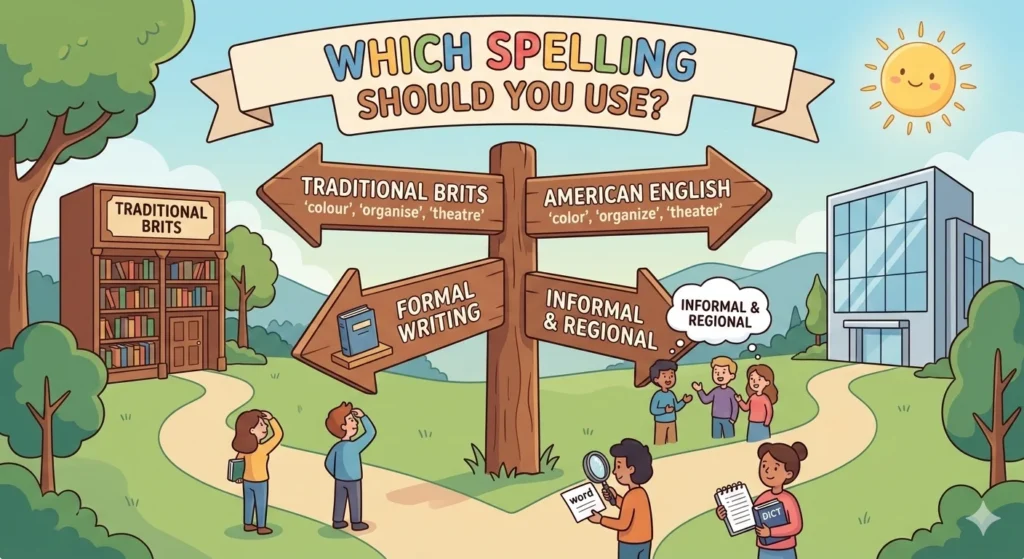
- Use “Digitize” (with a Z) if your audience is primarily in the United States. This is the standard spelling for American English .
- Use “Digitise” (with an S) if your audience is in the UK, Australia, New Zealand, or other Commonwealth countries. While the “Z” form is understood, the “S” form will look more natural and professional to them .
- For global audiences, you have two choices. For very technical or academic work, the “-ize” spelling is historically strong. However, for general business writing, picking one and being consistent is more important than which one you pick. Many global companies use the “-ize” form as a standard.
Is it digitalized or digitalised?
Both are correct. Use “digitalized” in the US and “digitalised” in the UK.
Common Mistakes with Digitize and Digitalize
Even experts slip up sometimes. Here are the most frequent errors to watch out for.
- Using them as synonyms. This is the biggest mistake. Remember: Digitize is about the data; Digitalize is about the process. You digitize a document, but you digitalize a workflow .
- Incorrect: “We need to digitalize all these paper contracts.”
- Correct: “We need to digitize all these paper contracts.”
- Correct: “By using AI to review those digitized contracts, we can digitalize our legal review process.”
- Forgetting the spelling differences. Writing “digitalisation” with an “S” for a US company in New York will look like a typo, and writing “digitalization” with a “Z” for a UK government agency might look slightly off. Pay attention to your audience .
- Confusing it with “Digital Transformation.” Digitalization changes processes, but Digital Transformation changes the entire business model, culture, and strategy . Digitalization is a part of digital transformation, but it is not the whole thing.
- Digitalization: Moving from paper timesheets to a mobile app for clocking in.
- Digital Transformation: Using the data from that mobile app to completely redesign your staffing levels, payroll, and project profitability models.
Digitize and Digitalize in Everyday Examples
Seeing these words in context makes it much easier to understand the difference.
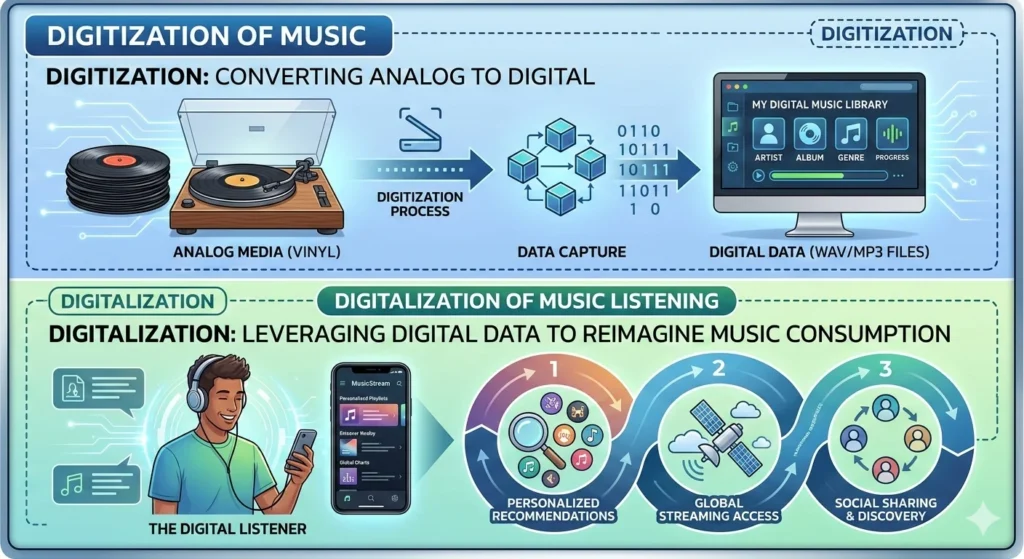
What do you mean by digitalize?
In a business report: “To stay competitive, we must digitalize our supply chain to allow for real-time tracking and automated reordering.”
(This means using tech to change the whole process, not just putting a PDF online.)
What does it mean to digitize something?
In a tech tutorial: “You can digitize your old cassette tapes using this simple USB converter.”
(This means turning analog audio into an MP3 file.)
In the news: “The library received a grant to digitize its collection of 19th-century newspapers.”
(This means scanning the old papers to create digital images and searchable text.)
On social media: “I’m finally digitizing all my recipe cards so I don’t lose them!”
(This means taking photos or typing up the physical recipes.)
In a formal email: “Our goal for Q3 is to fully digitalize the client onboarding experience, reducing sign-up time by 50%.”
(This means redesigning the entire client sign-up process using digital tools.)
Digitize vs. Digitalize Google Trends & Usage Data
While specific numbers change, the data clearly shows that both terms are incredibly popular, but they are used in different contexts. A look at general search patterns reveals:
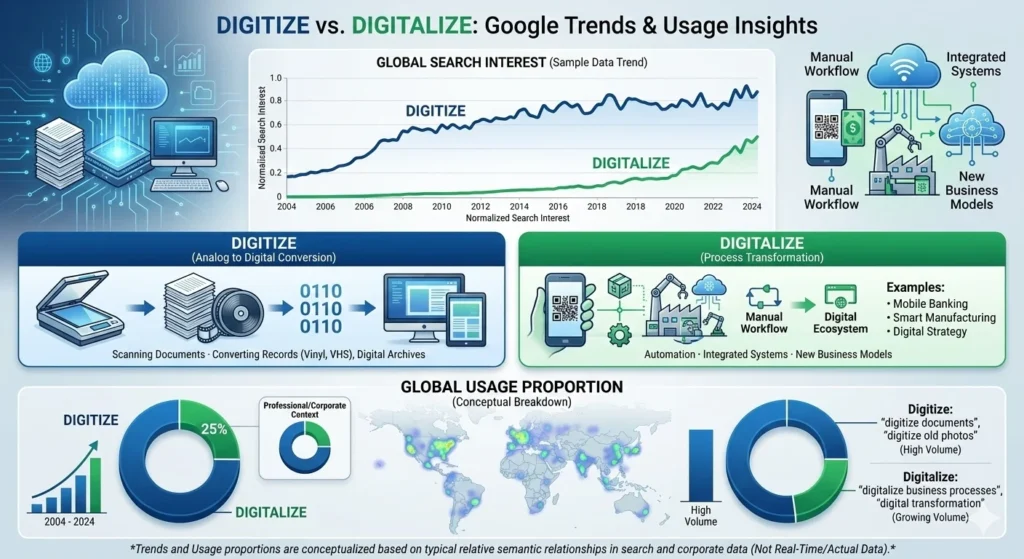
- “Digitize” and “Digitization” are steady, evergreen terms. They are used in a wide variety of fields, from history (digitizing archives) to personal use (digitizing photos). They are understood by almost everyone .
- “Digitalize” and “Digitalization” have seen a sharp rise in usage over the last decade, specifically in business, management, and IT publications. This spike correlates with the global push for Industry 4.0, remote work, and AI integration .
Geographically, both terms are searched globally, but “Digitalization” is an extremely popular keyword in Europe and parts of Asia, where large-scale business and government initiatives often use this terminology. In the US, while “Digitalization” is understood in corporate circles, the term “Digital Transformation” is often more common in everyday business language .
Comparison Table: Meaning and Usage
| Feature | Digitization | Digitalization |
|---|---|---|
| Focus | Information & Data | Processes & Workflows |
| Main Action | Converting | Improving / Changing |
| Key Question | “How do we make this physical thing digital?” | “How do we use digital tools to do this better?” |
| Outcome | A digital file (e.g., PDF, JPEG, MP3) | An automated or optimized process (e.g., automated billing) |
| Example | Typing handwritten notes into a Word doc. | Using AI to summarize those notes and assign action items to a team. |
Frequently Asked Questions (FAQs)
1. Can a company be digitized but not digitalized?
Yes. Imagine a law firm that scans all its paper case files into a cloud server. They have digitized their information. However, if their lawyers still print those files to read them, or if they email documents back and forth for edits, they have not digitalized their legal workflows .
2. Is it digitalized or digitalised?
It depends on your audience. Digitalized (with a Z) is the standard spelling in American English. Digitalised (with an S) is the more common spelling in British and Australian English .
3. What do you mean by digitalize?
To digitalize means to change a business process or method by using digital technology. For example, a restaurant that switches from taking orders with a pen and paper to using handheld tablets at the table is digitalizing its ordering process .
4. What does it mean to digitize something?
To digitize something means to take an object or signal that is not digital (like a photograph, a sound, or a paper document) and convert it into a digital format that a computer can read, store, and display .
5. What is the difference between digitization and digital transformation?
Digitization is a technical task (paper to PDF). Digitalization changes a specific process (using digital tools to make a task better). Digital Transformation is the big-picture change in a company’s strategy, culture, and customer value, powered by many acts of digitization and digitalization .
6. How do you pronounce “digitize”?
In both American and British English, it is pronounced DIJ – ih – tyze. The “g” is soft, like in “digital” .
7. Is “digitize” only for paper documents?
No, you can digitize almost any analog signal. This includes sounds (vinyl records, cassette tapes), images (film negatives, printed photos), and video (VHS tapes) .
Conclusion
Navigating the world of “digitize” and “digitalize” doesn’t have to be stressful. The key takeaway is to remember that these words are not interchangeable. Think of digitize as the first step—the technical act of converting atoms into bits, like scanning a photo or a document. Think of digitalize as the exciting second step—using those bits to change how you work, like using an app to order your scanned photos as prints or automating approvals for those scanned documents.
For spelling, simply know your audience. Use the “-ize” form for American readers and the “-ise” form for British and Commonwealth readers. By mastering this simple distinction, you will communicate more clearly, plan better business strategies, and avoid a common pitfall that confuses even the experts. Now you have the knowledge to use these powerful words with confidence.

“Samuel Butler was a sharp, insightful writer. At Wishveb.com, he inspires readers with clever, heartfelt wishes that connect emotions beautifully.”