Have you ever been typing an email and stopped cold, wondering whether to write equalling or equaling? You are not alone. This small spelling question trips up many people, from students to professional writers.
People search for equalling or equaling because they want to write correctly. They might be working on a school paper, a business report, or even a math problem. The confusion is simple: one word has two spellings, and both look right. But which one is correct?
This article solves that problem. You will learn the quick answer, the history behind the two spellings, and exactly which form to use based on where you are or who you are writing for. By the end, you will never have to guess again.
Equalling or Equaling means
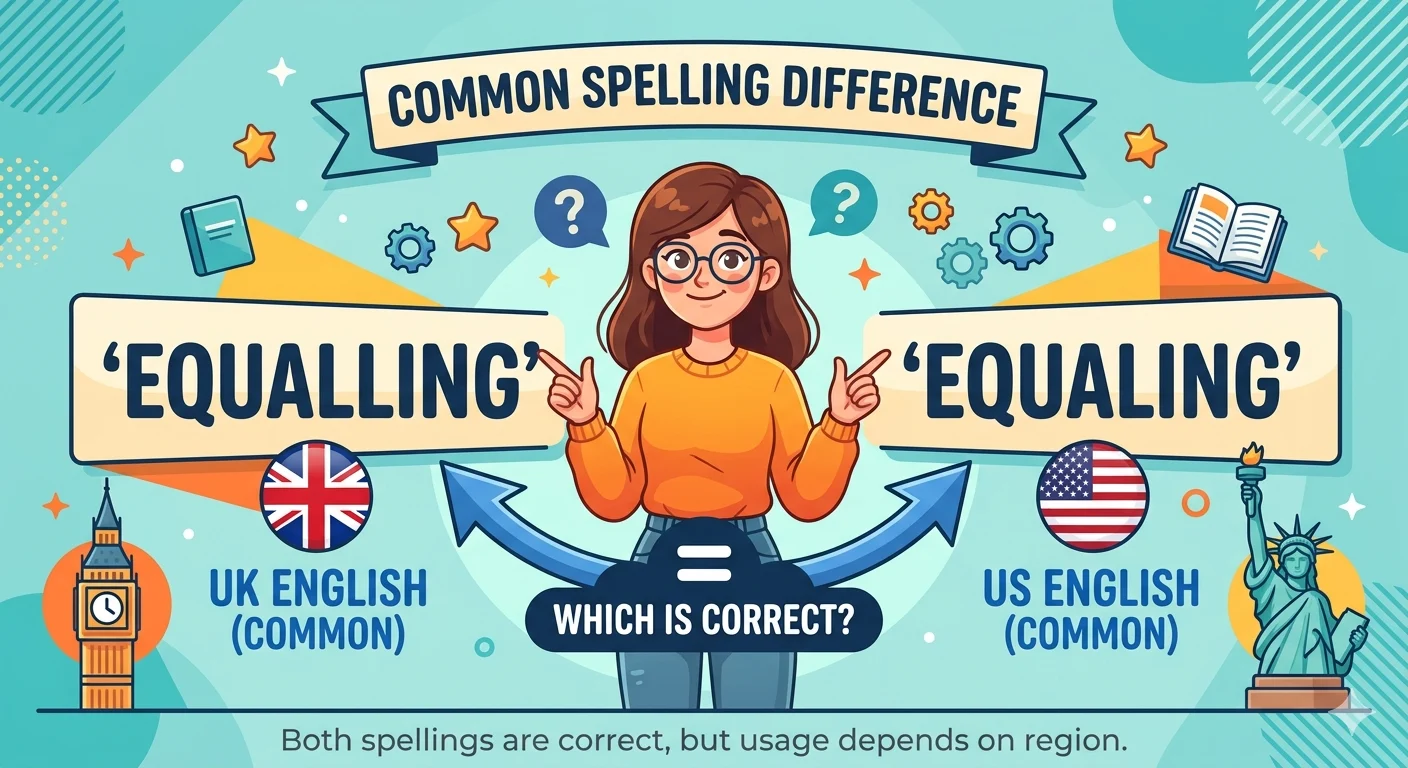
Both equalling and equaling are correct spellings of the same word. The difference depends on where you are writing.
- Equalling (with double *l*) is the preferred spelling in British English and other Commonwealth countries like Australia, Canada, and New Zealand.
- Equaling (with one *l*) is the standard spelling in American English.
For example:
- British English: She is equalling the world record.
- American English: She is equaling the world record.
Both forms mean the same thing: to be equal to something or to match it.
The Origin of Equalling or Equaling
The word comes from the Latin aequus, meaning “level” or “equal.” It entered English through Old French as egal before becoming equal.
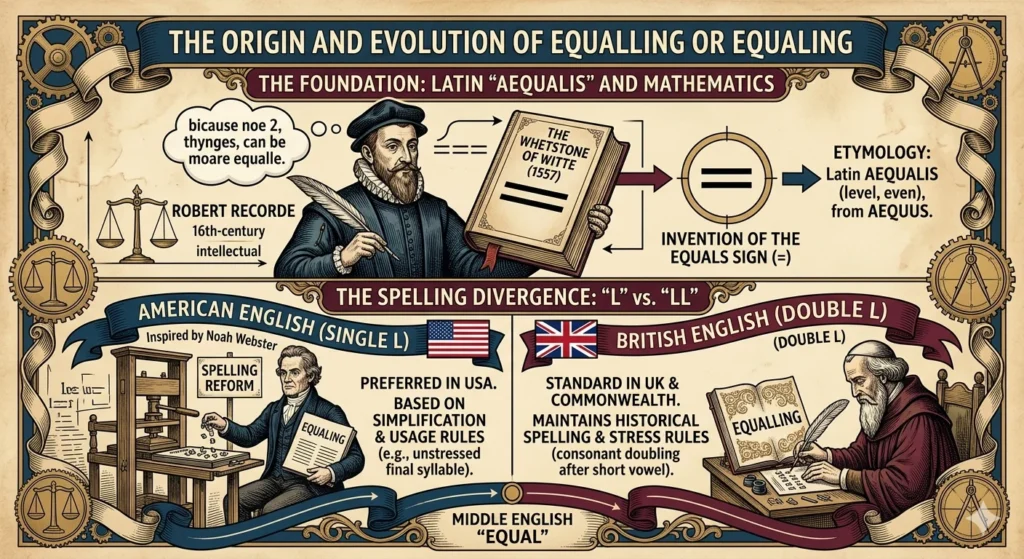
The spelling difference arises from how English handles verb endings. In British English, when adding -ing to a verb that ends with a single vowel followed by a single consonant, the final consonant is often doubled. In American English, this doubling is less common, especially if the stress is not on the final syllable.
For the verb equal, the final *l* is doubled in British English (equalling) but left single in American English (equaling). This pattern appears in other words too, such as travelling (UK) versus traveling (US).
British English vs American English Spelling
The core rule is simple. British English tends to double the final *l* when adding -ing, *-ed*, or *-er*. American English does not.
Here is how the two systems compare:
| Word Form | British English | American English |
|---|---|---|
| Base verb | equal | equal |
| Present participle (-ing) | equalling | equaling |
| Past tense (-ed) | equalled | equaled |
| Past participle | equalled | equaled |
Examples:
- UK: His score was equalled by a new player.
- US: His score was equaled by a new player.
This pattern is consistent across many verbs ending in *l*. The choice between equalling or equaling is simply a matter of following the spelling rules of your audience.
Which Spelling Should You Use?
Your choice depends on who will read your writing.
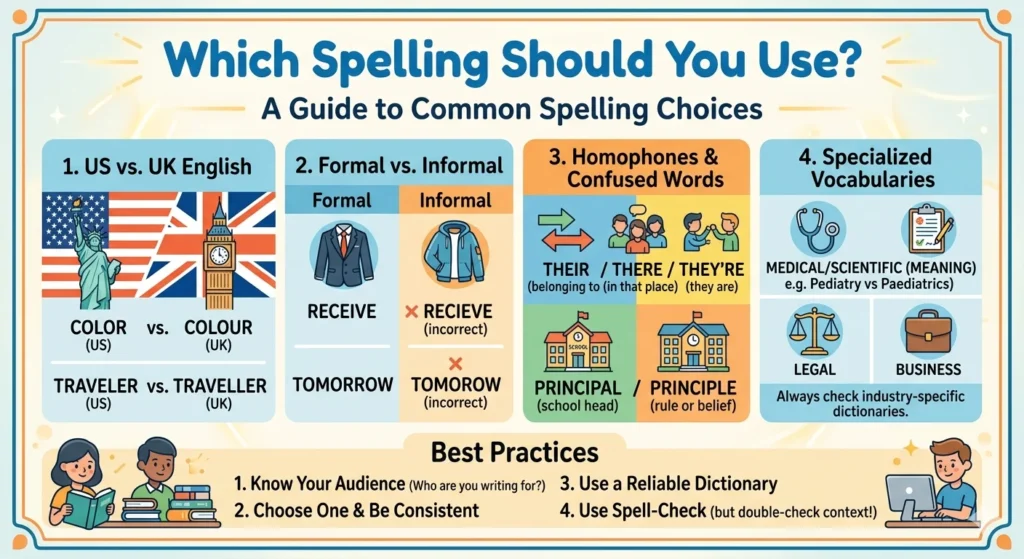
- Use equaling if you are writing for an American audience. This includes US schools, businesses, and publications.
- Use equalling if you are writing for a British, Australian, Canadian, or other Commonwealth audience. This is also the preferred form in international English contexts like the United Nations or European Union documents.
- For global audiences, choose one style and stick to it throughout your document. Consistency matters more than the specific choice.
If you are writing for math or science journals, check the journal’s style guide. American journals will use equaling, while British journals will use equalling.
Common Mistakes with Equalling or Equaling
Even when writers know the rule, mistakes still happen. Here are the most common errors:
- Mixing spellings in one document
Switching between equalling and equaling looks unprofessional. Pick one style and stay with it. - Using the wrong form for the audience
A US reader may see equalling as a misspelling. A UK reader may see equaling the same way. - Forgetting the past tense
The same rule applies to equaled (US) and equalled (UK). Many people remember the -ing form but forget the past tense. - Confusing with equating
Equating means to consider two things as equal or to connect them mathematically. What is the meaning of equaling? It means to be equal to something in value, amount, or quality. These are different actions.
Equalling or Equaling in Everyday Examples
Seeing the word in real contexts helps clarify usage.

In emails:
- US: Our sales this quarter are equaling last year’s numbers.
- UK: Our sales this quarter are equalling last year’s numbers.
In news headlines:
- US: Athlete Equaling Record After Comeback
- UK: Athlete Equalling Record After Comeback
In social media:
- No one is equaling her style. (US)
- No one is equalling her style. (UK)
In formal writing:
- The new policy is not equaling the expected outcomes. (US)
- The new policy is not equalling the expected outcomes. (UK)
In math:
When discussing mathematics, equalling or equaling in math often refers to values that match. For example: The sum of the angles is equaling 180 degrees.
Equalling or Equaling Google Trends & Usage Data
Search data shows clear regional patterns.
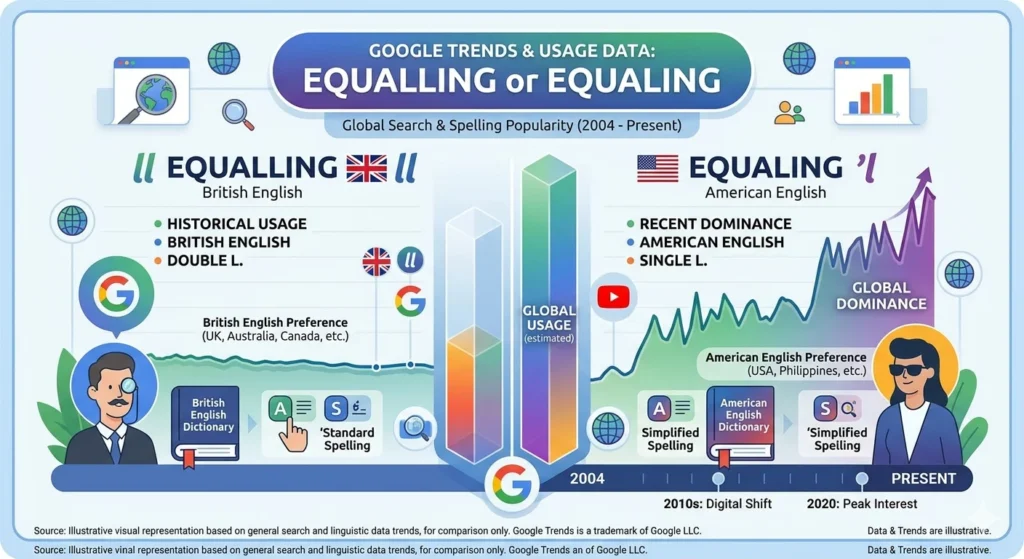
- In the United States, equaling is searched far more often than equalling.
- In the United Kingdom, Australia, and New Zealand, equalling is the dominant search form.
- Canada shows a mix, with a slight preference for the British spelling due to Commonwealth influence.
In professional writing, American English dominates global business and tech content. However, British English remains strong in academic publishing, law, and international organizations.
If you are writing for a global audience and are unsure, many style guides now recommend choosing one form and using it consistently. The worst choice is to mix them.
Comparison Table: Equalling or Equaling
| Feature | Equalling | Equaling |
|---|---|---|
| Spelling | Double *l* | Single *l* |
| Primary Region | UK, Australia, NZ, Canada, Commonwealth | United States |
| Past Tense | Equalled | Equaled |
| Present Participle | Equalling | Equaling |
| Example Sentence | She is equalling the champion’s score. | She is equaling the champion’s score. |
| Style Guide | Oxford, Cambridge | Chicago, AP |
FAQs
1. How do you use equalling in a sentence?
You use equalling as the present participle of equal in British English. Example: The company’s growth is equalling that of its top competitor.
2. How do you spell equaling in the UK?
In the UK, the correct spelling is equalling with two *l*’s. This follows British English spelling rules for doubling consonants before adding -ing.
3. Is it equalling or equaling?
Both are correct. Use equalling for British English and equaling for American English. Your audience determines the correct choice.
4. What is the meaning of equaling?
Equaling means to be the same as something in value, amount, size, or quality. It can also mean to match or reach the same level as another.
5. Is equaling a word?
Yes, equaling is a word. It is the standard American English spelling of the present participle of equal.
6. What is a synonym for equaling?
Synonyms include matching, rivalling (or rivaling), touching, reaching, and paralleling.
7. What is the difference between equating and equaling?
Equating meaning involves considering two things as equal or connecting them in meaning. Equaling means they are already equal in value or measure. You equate concepts; numbers or scores can equal each other.
Conclusion
The choice between equalling or equaling comes down to one simple factor: your audience. British and Commonwealth English use the double *l* form, while American English uses the single *l*. Both are correct within their own systems.
Remember that the same rule applies to other forms like equalled and equaled. Consistency is key. Pick one spelling style and use it throughout your document. This small attention to detail makes your writing look polished and professional.
Now that you understand how do you use equalling in a sentence and how do you spell equaling in the UK, you can write with confidence. Whether you are sending an email, publishing an article, or solving a math problem, you will never have to pause and wonder again.

“Bram Stoker was a creative storyteller known for his powerful writing style. At Wishveb.com, he inspires readers with heartfelt, expressive wishes.”