We’ve all been there. A friend betrays your trust, a partner tells a lie, or a family member does you wrong. In the heat of the moment, you’re faced with a classic dilemma. People search for “forgive or forget” to find clarity on how to handle these painful situations.
Is it better to wipe the slate clean entirely, or is letting go of anger enough, even if the memory remains?
This confusion is often deepened by the famous TV show, common quotes, and even grammar questions. This article solves that by exploring the real meaning, the history, and giving you practical advice on navigating this tricky choice.
Forgive or Forget means
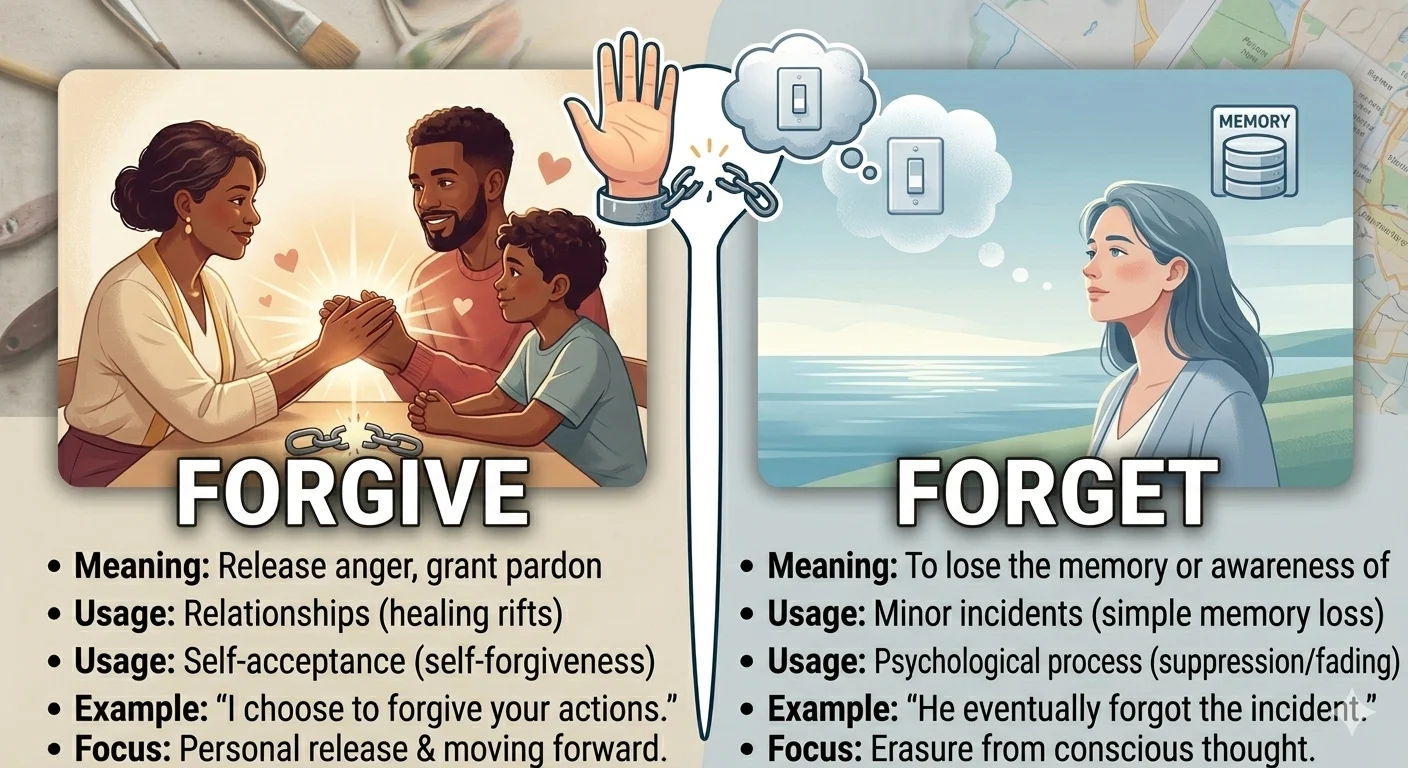
In short, “forgive or forget” usually presents two choices. To forgive means to let go of anger and stop blaming someone for a wrong they did. To forget means to actively remove the memory of the event from your mind. In real life, forgiving is often healthy, but forgetting is not always possible or wise. For example, you might forgive a friend for borrowing money and not paying it back, but you probably won’t forget that they are unreliable with loans. This phrase is also famous as the title of a 1990s TV show hosted by Mother Love, where people confronted loved ones to seek reconciliation .
The Origin of Forgive or Forget
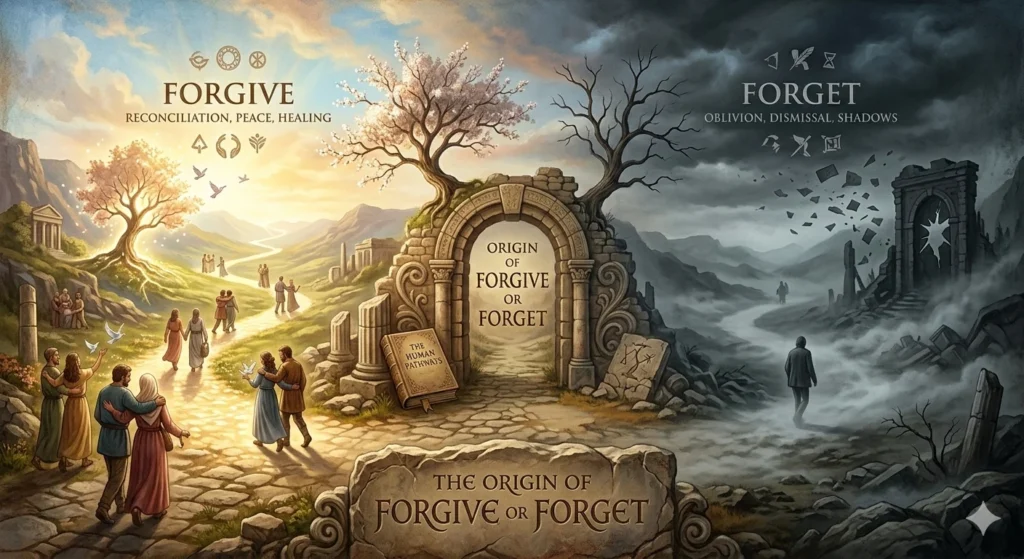
The exact phrase we use today comes from the older proverb “forgive and forget.” According to idiom dictionaries, this idea has been around since the 1300s. It appeared in the famous poem Piers Ploughman by William Langland around 1377 . It was already a common proverb by the mid-1500s and was even used by Shakespeare in King Lear, where he wrote it as “forget and forgive” . The spelling has remained consistent because it’s a combination of two Old English words: forgiefan (to give or grant) and forgetan (to lose memory of).
British English vs American English Spelling
Good news: when it comes to the words “forgive” and “forget,” there is no difference between British and American spelling. The spelling is standardized in all forms of English. However, the structure of the phrase can change slightly depending on how you use it.
| Variation | British English Example | American English Example |
|---|---|---|
| Base Phrase | It is best to forgive and forget. | It is best to forgive and forget. |
| Verb Conjugation | She forgave and forgot his rude comment. | She forgave and forgot his rude comment. |
| Noun Form | Practising forgive and forget is hard. | Practicing forgive and forget is hard. |
| Modern Usage | He chose to forgive but not forget. | He chose to forgive but not forget. |
As you can see, the words themselves are spelled the same way in both dialects .
Antipasto or Antipasta: Don’t Make This Food Spelling Error 🚫🍝
Which Spelling Should You Use?
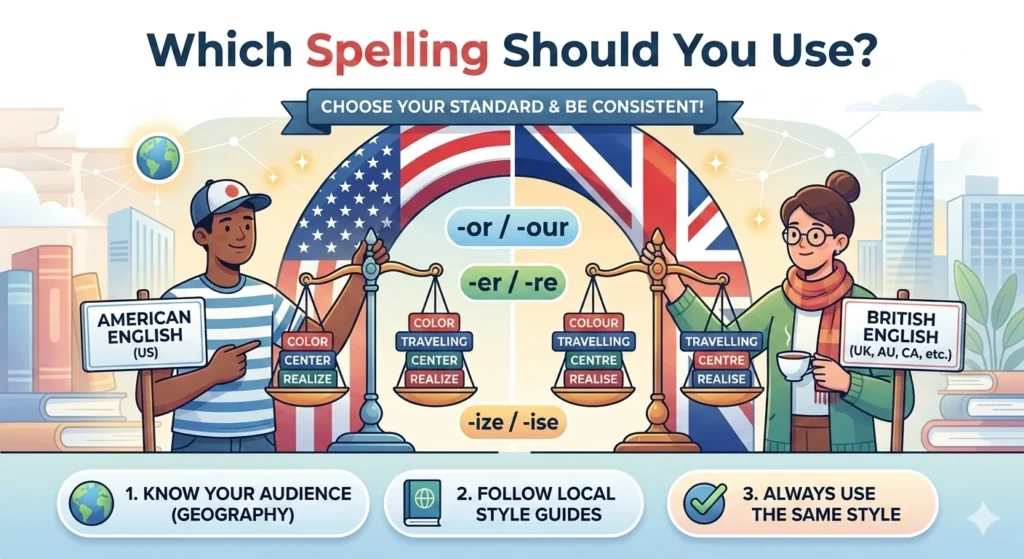
Since the spelling is universal, your choice depends on your audience in terms of context, not country.
- For a US Audience: You can confidently use “forgive or forget” when discussing the moral dilemma or the pop culture references like the Mother Love Forgive or Forget show .
- For a UK or Commonwealth Audience: The same spelling applies. You might be more likely to use it in the classic proverb form, “forgive and forget.”
- For a Global Online Audience: Stick with the standard spelling. If you are looking for old episodes, searching for “Forgive or Forget season 1” or “Forgive or Forget videos” will work everywhere.
Common Mistakes with Forgive or Forget
People often make mistakes when using this phrase, either in meaning or in grammar.
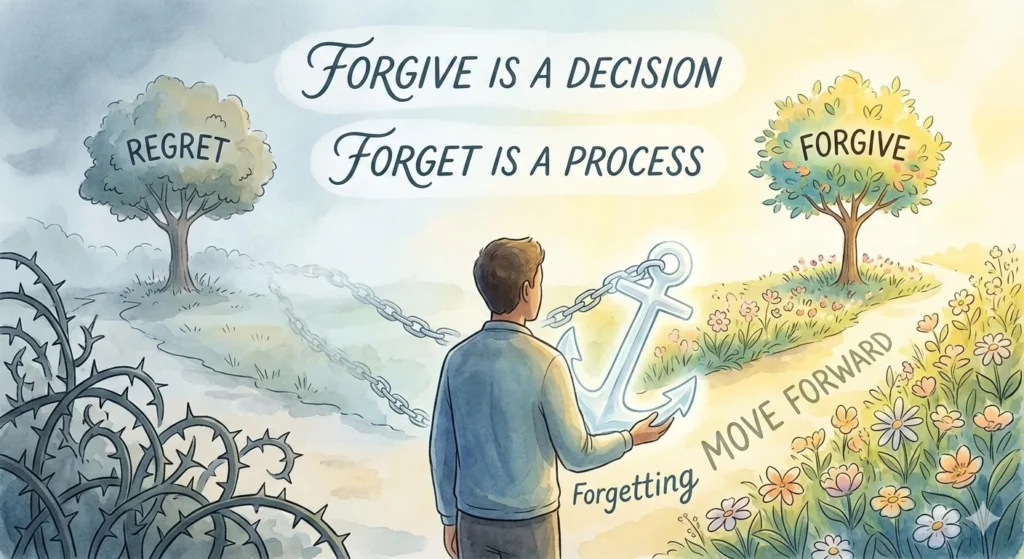
- Mistake 1: Confusing it with “Let bygones be bygones.” While similar, “forgive and forget” implies a personal wrongdoing where one party is at fault. “Let bygones be bygones” is more general and suggests that both parties should move on from a mutual disagreement .
- Mistake 2: Thinking it’s a direct command from the Bible. Many people believe this is a biblical commandment. However, experts point out that the exact phrase “forgive and forget” does not appear in the Bible . The Bible talks a lot about forgiveness, but not about forgetting.
- Mistake 3: Grammatical errors. Remember that “forgive” is a verb. You don’t “do a forgive.” You simply forgive someone. Also, when using it as a compound noun, it stays as is: “I don’t trust forgive or forget as a life strategy.”
Forgive or Forget in Everyday Examples
You will see and hear this phrase everywhere, from deep conversations to social media posts.
- In Email (Formal): “While I appreciate your apology, I think it’s optimistic to simply forgive or forget the incident without discussing it further.”
- On Social Media (Informal): A user might post a picture of a celebrity who cheated with the caption, “Fans are debating whether to forgive or forget his actions.” Others might quote lyrics like “forgive or forget lyrics sarah close” to express their feelings.
- In News Headlines: “The public is asked to forgive and forget the politician’s past scandals as he announces his comeback.”
- In TV Show Context: Fans often ask, “Who hosted forgive or forget? ” (Mother Love, then Robin Givens) or “Where can I watch forgive or forget? ” to see old episodes where people confront their past .
Forgive or Forget – Google Trends & Usage Data
The interest in “forgive or forget” comes from two main areas: the philosophical question and the 90s TV show.
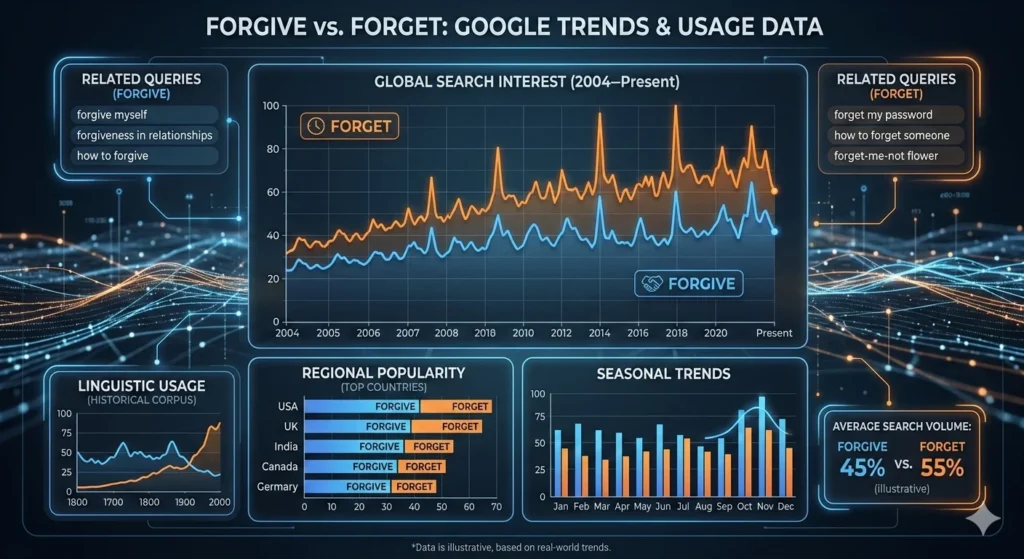
- TV Show Popularity: The phrase spiked in the late 1990s when the talk show hosted by Mother Love aired. Fans still search for “Forgive or Forget episode season 1 episode 50” or “Forgive or Forget TV show full episodes” to relive the drama.
- Modern Queries: Today, searches are mixed. Many people look for the “forgive or forget meaning” to apply to their lives. Others look for merchandise like the “i don’t trust forgive or forget shirt,” which suggests a modern, cynical take on the old proverb .
- Country Data: The phrase is most popular in the United States, likely due to the show’s origin, but it is also commonly searched in the UK, Canada, and Australia.
Here is a quick look at the different ways the phrase is used:
Frequently Asked Questions
Is it better to forgive or forget?
Experts in psychology generally agree it is better to forgive for your own peace, but you don’t have to forget. Forgetting a dangerous situation could put you at risk again. Remembering the lesson is a form of self-protection .
Who hosted forgive or forget?
The show was originally hosted by the charismatic comedian Mother Love. In January 2000, she was replaced by actress Robin Givens for the remainder of the second season .
Where can I watch forgive or forget?
The show originally aired from 1998 to 2000. Reruns have aired on networks like Bounce TV in the past. Currently, you can search for “Forgive or Forget videos” on video-sharing platforms like YouTube, or look for “Forgive or Forget episodes” on streaming services that carry classic TV shows.
What does “forgive or forget” mean?
It presents a choice between two actions. To forgive is to release feelings of resentment. To forget is to erase the memory of the offense. The phrase is often used to ask whether a person can truly move past a transgression .
What is the “Mother Love Forgive or Forget” connection?
Mother Love was the original and most famous host of the Forgive or Forget TV show. She became the face of the series, known for her warm but firm style of mediating conflicts between guests .
Is “I don’t trust forgive or forget” a quote?
Yes, this sentiment has become popular, especially on merchandise like t-shirts. It reflects the idea that people who claim to “forgive and forget” might be hiding their true feelings, or that forgetting is an unhealthy way to handle betrayal.
Can you write a forgive or forget essay?
Absolutely. A good essay could compare the traditional proverb with modern advice, using examples from the TV show, historical origins, and personal relationships. It could argue that forgiving is a strength, but forgetting is not always a realistic goal.
Are there any famous “forgive or forget quotes”?
Yes, many. One of the most famous is from Alexander Pope: “To err is human; to forgive, divine.” A more modern take is, “I can forgive, but I cannot forget,” often attributed to various authors.
Conclusion
So, forgive or forget? The answer isn’t always black and white. We’ve learned that while the ancient proverb encourages us to do both, real life is more complex. The popular 90s TV show, hosted by Mother Love, tried to force this moment of truth on stage, but in reality, healing happens over time. Remember that forgiving is about freeing yourself from the heavy burden of anger—it’s a gift you give yourself. Forgetting, however, is not always under your control, nor should it be. You can forgive someone and still remember the lesson they taught you. Whether you are pondering the philosophical meaning, searching for old episodes, or deciding how to handle a personal hurt, the healthiest path is usually to forgive for your own sake, but keep the wisdom the experience gave you.

“John Galsworthy was a refined storyteller known for expressive, emotional writing. At Wishveb.com, he brings graceful, heartfelt wishes to readers.”