Do you stop typing when you get to the word that means “a thing that gets in the way”? You are not alone.
Many people ask: Is hinderance a word? Or should it be “hindrance”? This small spelling problem causes big confusion.
People search for this keyword because they want to write with confidence. They see both spellings online and in books.
This article solves that confusion. It gives you a clear, simple answer. You will learn the correct spelling, the history, and how to use the word in real life. By the end, you will never second-guess this word again.
Hindrance means
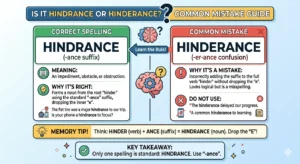
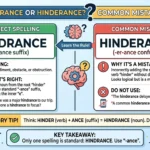
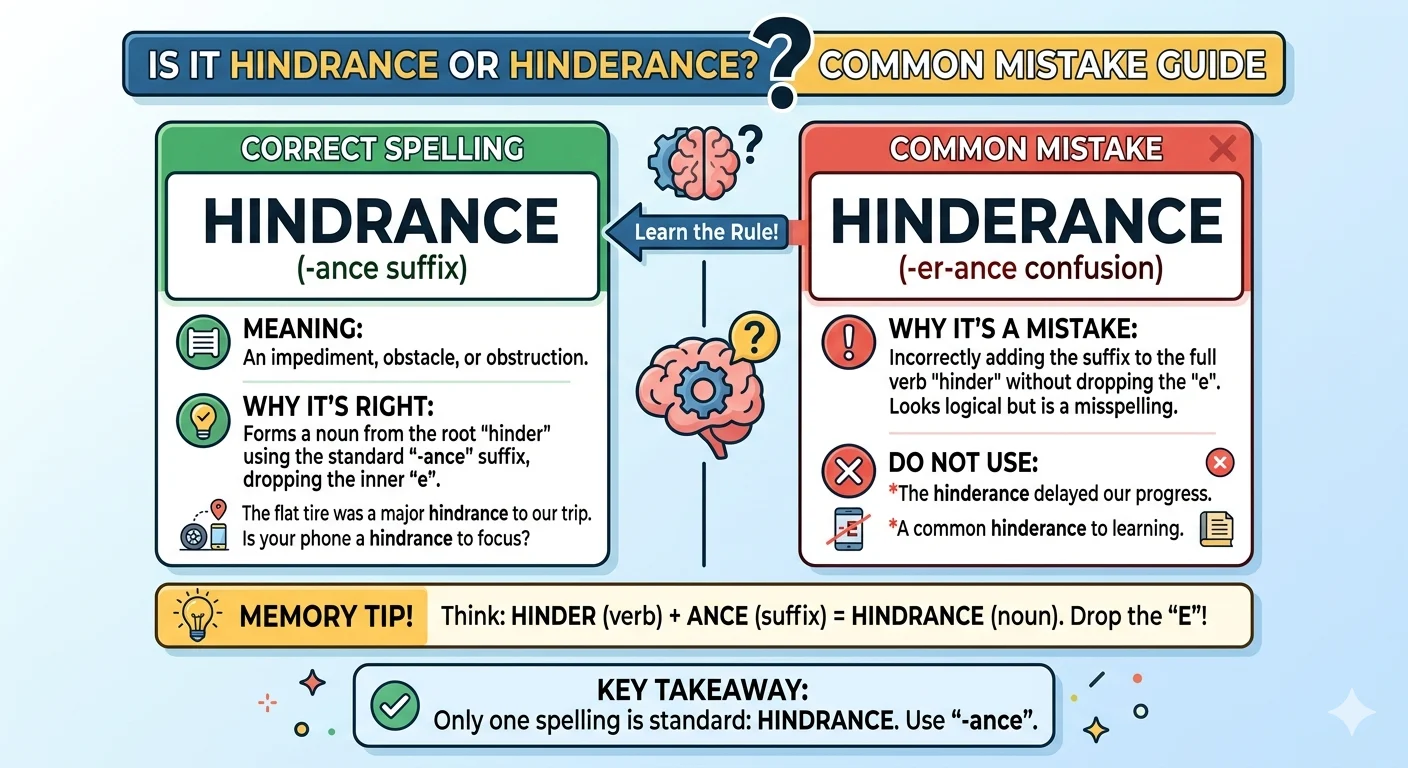
Hindrance is the correct spelling. It means an obstacle or something that causes delay.
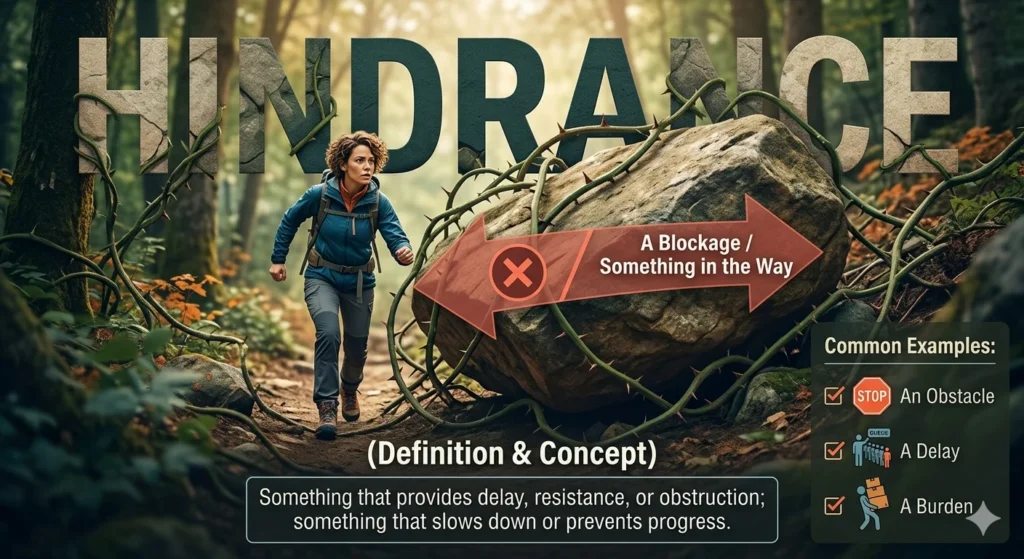
For example:
- “The heavy rain was a hindrance to our travel plans.”
- “His lack of experience was not a hindrance to getting the job.”
Hinderance is a common misspelling. You will see it sometimes, but it is not the standard form. Most dictionaries do not list it as a correct variant. If you want to write professionally, always use hindrance.
The Origin of Hindrance
The word comes from the Old English verb hindrian, which meant “to hold back” or “to harm.” This verb traces back to the Proto-Germanic word hindrōną.
The noun form appeared in Middle English as hindrance. The spelling was set by the 15th century. The “-ance” ending is common in English for nouns that come from verbs (like compliance from comply).
So why does hinderance exist? People see the verb hinder and add -ance. This seems logical. But English does not always follow logic. The correct noun form drops the “e” from the verb. This is a common pattern. For example, remember becomes remembrance, not rememberance.
British English vs American English Spelling
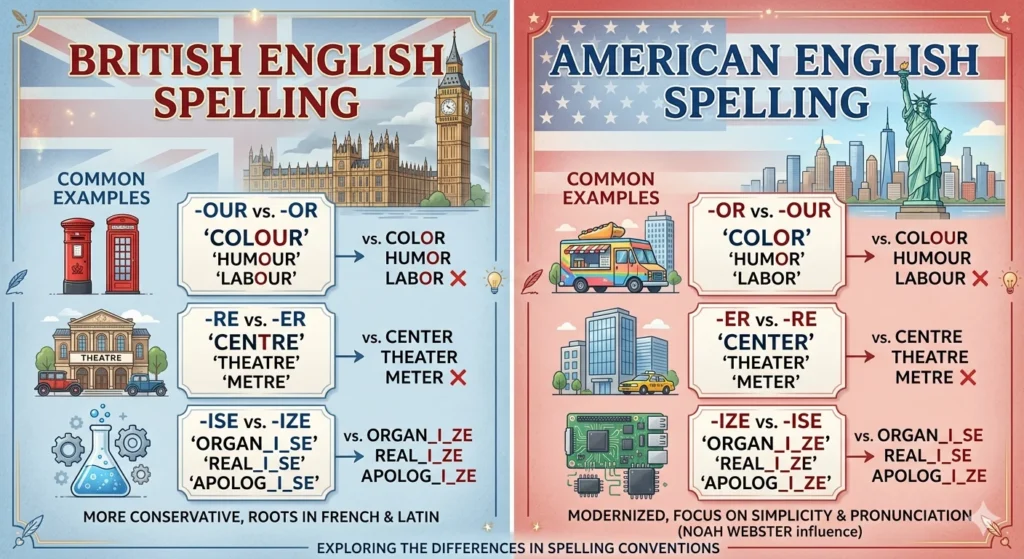
Good news: there is no difference here. Both British and American English use hindrance. This is rare. Many English words have two spellings (like color and colour). But hindrance is the same in both dialects.
| Variety | Spelling | Example |
|---|---|---|
| British English | hindrance | “The traffic was a major hindrance.” |
| American English | hindrance | “His injury was a hindrance to the team.” |
| Canadian English | hindrance | “Red tape is often a hindrance.” |
| Australian English | hindrance | “The weather proved a hindrance.” |
Hinderance is not accepted in any standard dialect. It is simply a mistake.
Which Spelling Should You Use?
Here is simple advice based on your audience:
- If you write for a US audience: Use hindrance. This is the only correct spelling in American English.
- If you write for a UK or Commonwealth audience: Use hindrance. The same rule applies.
- If you write for a global audience: Use hindrance. This ensures clarity and professionalism.
There is no situation where hinderance is the better choice. Even in casual writing, hindrance is the safe, correct option. If you are a student, a professional, or a content creator, always choose hindrance.
Common Mistakes with Hindrance
Here are the most frequent errors people make:
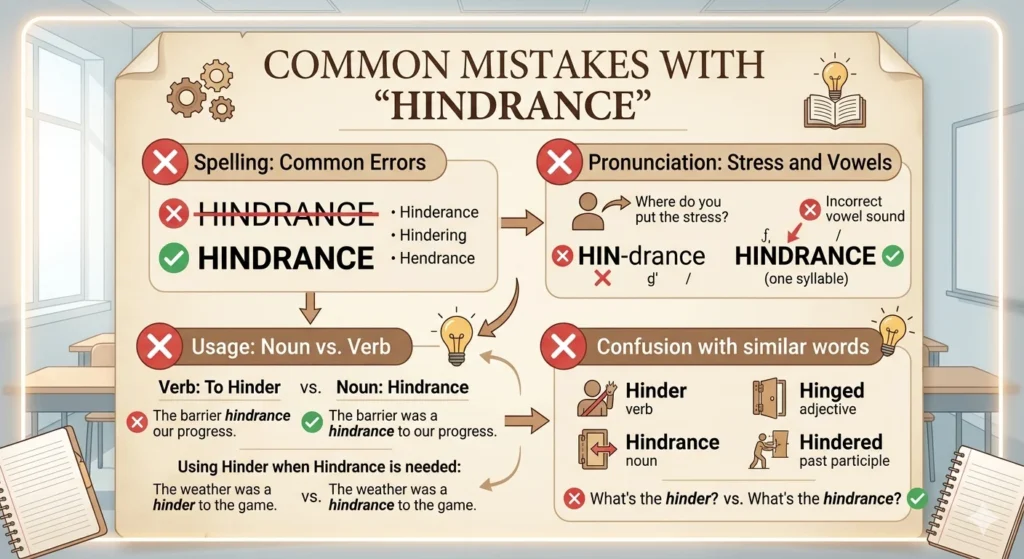
- Spelling it “hinderance”
- Incorrect: “The broken printer was a hinderance.”
- Correct: “The broken printer was a hindrance.”
- Using the wrong article: “a” vs “an”
- Many people ask: Is it a hindrance or an hindrance?
- The answer: a hindrance. The “h” is pronounced, so you use “a.”
- Correct: “This is a hindrance to progress.”
- Mispronouncing the word
- Hindrance pronunciation: It is said as “HIN-druhns” (two syllables).
- Incorrect: hin-DER-ance (three syllables).
- The correct pronunciation drops the middle “e” sound.
- Confusing it with “hinder”
- Hinder is a verb. Hindrance is a noun.
- “You hinder my work.” vs. “You are a hindrance to my work.”
- Asking: What is the meaning of Hinderation?
- Hinderation is not a real word. This is a common mistake. People add “-ation” to “hinder,” but the correct noun is hindrance.
Hindrance in Everyday Examples
Here is how the word appears in real-world contexts:
Emails (Professional)
“Please remove any software that may be a hindrance to the system update.”
News Headlines
“Lack of funding proves major hindrance for local schools.”
Social Media
“Trying to take a photo with my cat is a real hindrance. 😂”
Formal Writing
“The court ruled that the delay was an unreasonable hindrance to justice.”
You can also use it in the plural form. Hindrance plural is hindrances.
- “There were many hindrances on the path to success.”
Hindrance Google Trends & Usage Data
Data from Google Trends shows that hindrance is the dominant search term worldwide. Searches for hinderance exist but are much smaller. They often come from people asking: Is hinderance a word?
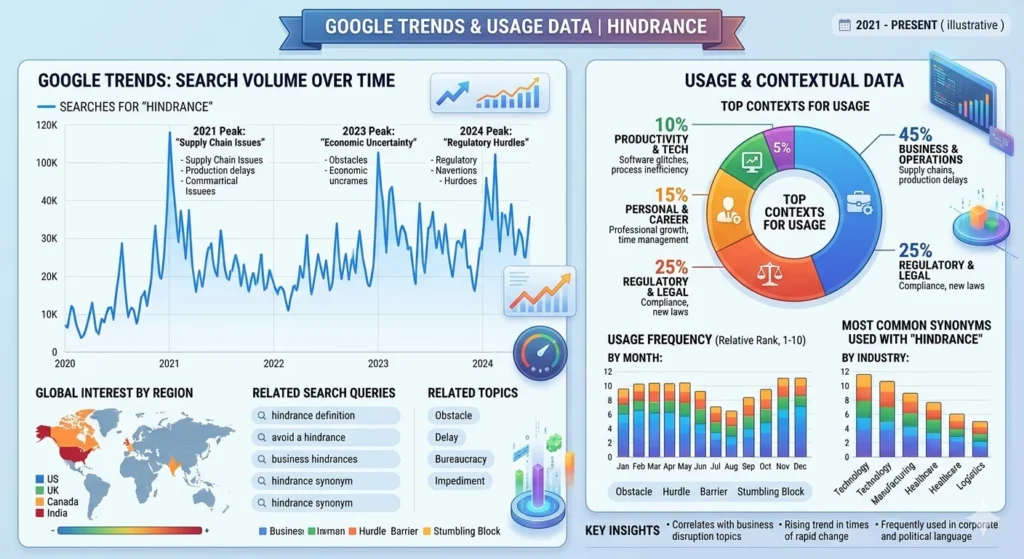
The word hindrance is most commonly searched in:
- The United States
- The United Kingdom
- India
- Australia
- Canada
Interest peaks during times when people write more—like during exam seasons, job application periods, and NaNoWriMo (National Novel Writing Month).
In professional and academic contexts, hindrance is used far more often. News articles, research papers, and government documents almost never use the misspelling.
Comparison Table: Hindrance vs Common Variations
| Term | Correct? | Notes |
|---|---|---|
| hindrance | ✅ Yes | Standard spelling in all English dialects. |
| hinderance | ❌ No | Common misspelling. Not found in major dictionaries. |
| hindrence | ❌ No | Rare misspelling. |
| hinder | ✅ Yes | Verb form. Different part of speech. |
| hindrances | ✅ Yes | Plural form. |
| hindering | ✅ Yes | Present participle of the verb. |
| hinderation | ❌ No | Not a real word. |
FAQs
1. Is hinderance a word?
No, hinderance is not a standard English word. It is a common misspelling of hindrance. Major dictionaries like Merriam-Webster and Oxford do not list it as a valid variant.
2. What is the meaning of hindrance?
A hindrance is something that causes delay, obstruction, or difficulty. It can be a person, object, or situation that makes progress harder.
3. What is the meaning of Hinderation?
Hinderation is not a real word. People sometimes use it by mistake when they want to mean hindrance. There is no correct usage for this term.
4. Is it a hindrance or an hindrance?
It is a hindrance. The “h” in hindrance is pronounced, so you use the article “a.” For example: “This is a hindrance to our success.”
5. Hinderance or hindrance meaning?
The meaning is the same if people use hinderance by mistake. But only hindrance is correct. It means an obstacle or something that holds you back.
6. What is a hindrance synonym?
Common synonyms include: obstacle, barrier, obstruction, impediment, block, hurdle, and setback.
7. How do you use hindrance in a sentence?
“His lack of a degree was not a hindrance to his career.” “The new rules created more hindrances than solutions.”
8. What is hindrance in tennis?
In tennis, a hindrance is any action that distracts a player during play. The umpire can call a hindrance and award the point to the other player.
9. How do you pronounce hindrance?
The hindrance pronunciation is “HIN-druhns.” It has two syllables. Do not say “hin-der-ance.”
10. What is the hindrance plural?
The plural is hindrances. For example: “We faced many hindrances along the way.”
Conclusion
Choosing between hinderance or hindrance is simple once you know the facts. Hindrance is the correct spelling in all forms of English. It has been the standard for centuries. The misspelling hinderance happens because people see the verb “hinder” and add “-ance.” But English has its own rules.
Remember these key points:
- Hindrance means an obstacle or delay.
- Use a hindrance, not “an hindrance.”
- The hindrance pronunciation has two syllables: HIN-druhns.
- The hindrance plural is hindrances.
- Hinderance is a mistake. Hinderation is not a word.
Now you can write with confidence. Whether you are sending an email, writing a report, or posting online, use hindrance. It is the professional, correct choice. Clear writing removes hindrances for your readers. And knowing the right spelling removes a hindrance for you.

“Samuel Butler was a sharp, insightful writer. At Wishveb.com, he inspires readers with clever, heartfelt wishes that connect emotions beautifully.”