Have you ever been asked to make an oath or affirmation and wondered what the difference is? You are not alone. Every day, thousands of people search for this topic because they face a legal form, a court date, or a citizenship ceremony.
The confusion is real: many people do not know which one to choose or what each word really means.
This article clears up that confusion. You will learn the simple difference between an oath and an affirmation, when to use each, and how to spell them correctly.
By the end, you will feel confident making the right choice for your situation. Whether you are filling out a verification on oath or affirmation form or preparing for court, this guide gives you the answers you need in plain, simple language.
Oath or Affirmation means
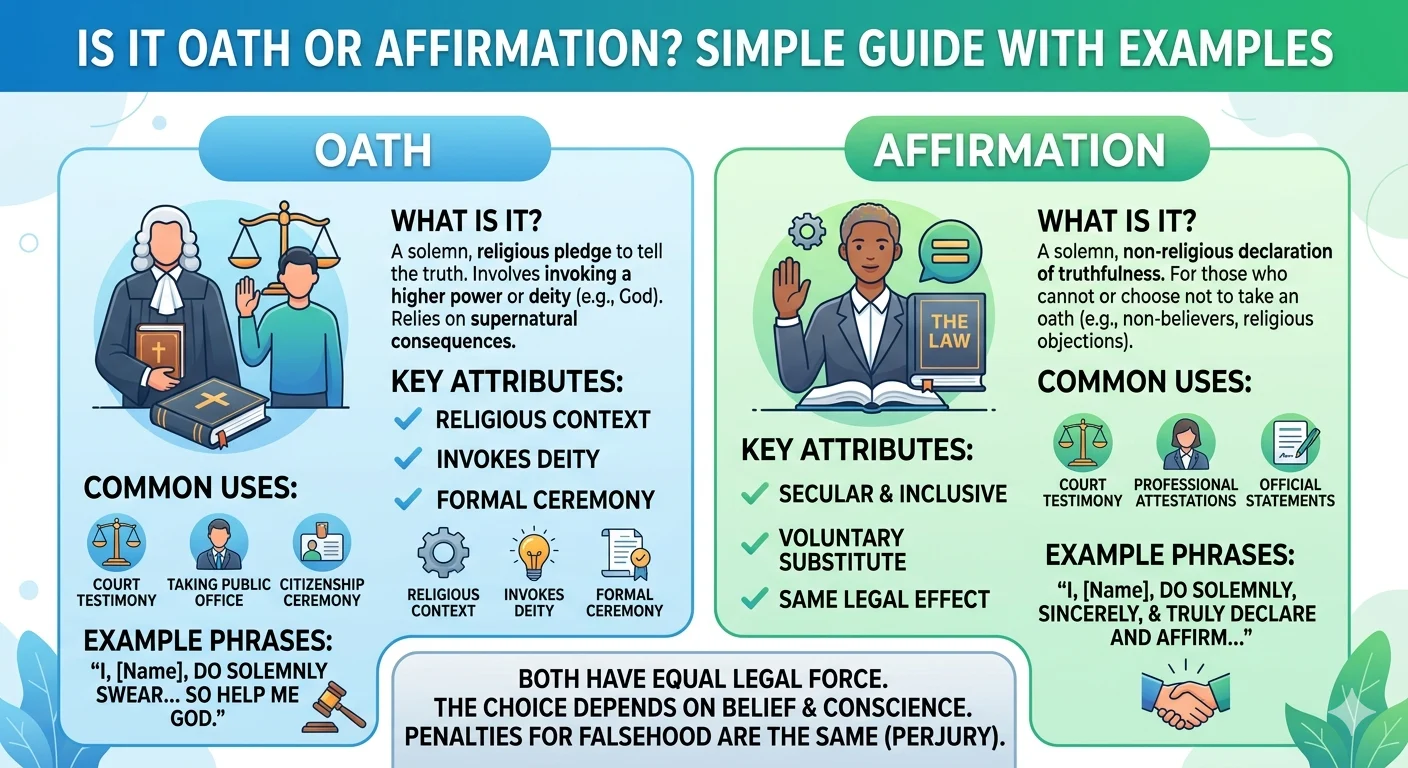
An oath is a promise made before a divine being, such as God. An affirmation is a solemn promise without any religious reference.
Examples:
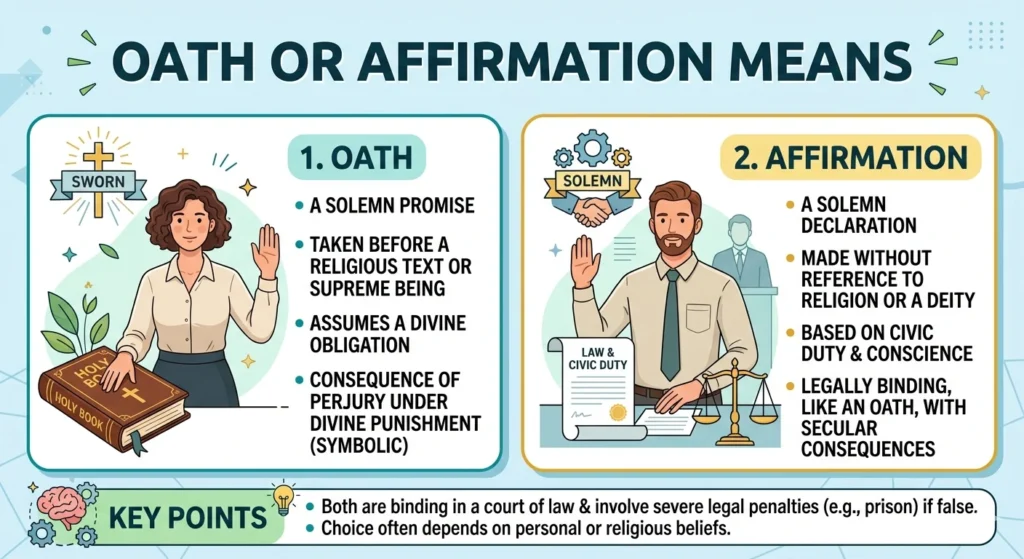
- Oath: “I swear by Almighty God that I will tell the truth.”
- Affirmation: “I solemnly and sincerely affirm that I will tell the truth.”
Both have the same legal effect. Neither is more valid than the other. The choice is personal, based on your beliefs or comfort.
The Origin of Oath or Affirmation
The word “oath” comes from Old English “āth,” meaning a solemn promise made to a deity. It has roots in ancient legal systems where promises were made in the name of a god.
“Affirmation” comes from Latin “affirmare,” meaning to make steady or strengthen. It entered legal use in the 17th century when religious groups like Quakers refused to swear oaths. They wanted a way to make binding promises without calling on God.
Spelling differences between “oath” and “affirmation” do not exist. They are two distinct words. However, the phrase oath or affirmation appears together in laws, forms, and court procedures. The “or” shows that you have a choice.
British English vs American English Spelling
The words “oath” and “affirmation” are spelled the same in both British and American English. However, there are slight differences in usage and common phrases.
| Term | British English Usage | American English Usage |
|---|---|---|
| Oath | Common in courts, Parliament, and ceremonies | Common in courts, military, and citizenship |
| Affirmation | Used by those with religious objections | Used by those with religious or ethical objections |
| Phrasing | “I swear by Almighty God…” | “I swear by Almighty God…” or “I affirm…” |
| Form Titles | Often “Oath or Affirmation of Office” | Often “Verification on Oath or Affirmation” |
In the UK, the difference between oath and affirmation in Parliament is notable. Members may affirm rather than swear. In the US, the fourth amendment requires that warrants be supported by oath or affirmation, showing the term appears in the Constitution itself.
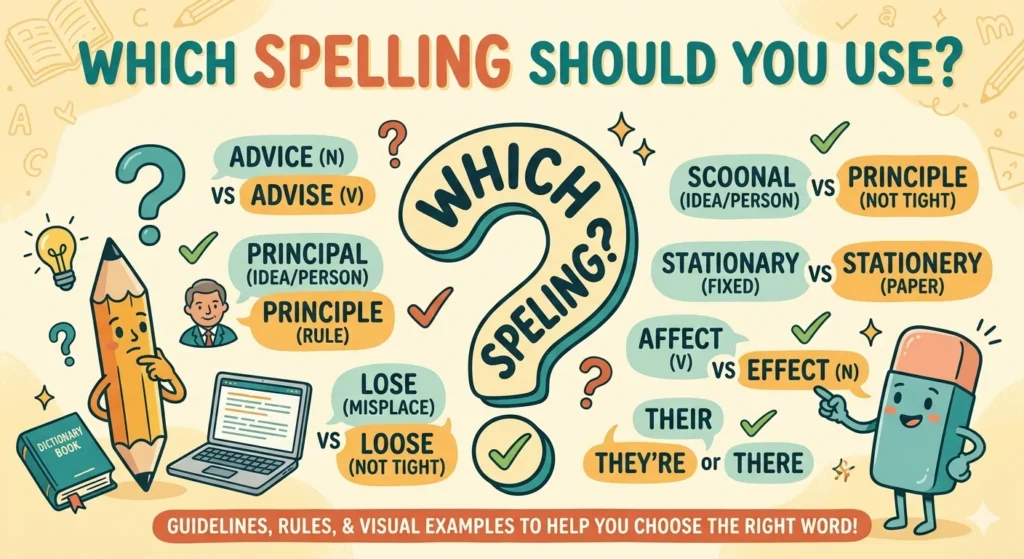
Which Spelling Should You Use?
Your choice depends on where you are and who you are speaking to.
For US audiences:
Use “oath” if you are in court, dealing with a notary, or filling out federal forms. Most legal documents in the US use the phrase verification on oath or affirmation. A notary must administer an oath or affirmation when notarizing sworn documents. In Florida, for example, the Florida notary oath or affirmation has specific wording required by state law.
For UK and Commonwealth audiences:
Use “oath” for religious promises and “affirmation” for non-religious ones. In Australia, you will see terms like oath or affirmation qld (Queensland) and oath or affirmation nsw (New South Wales) on legal forms. Each state has its own rules.
For global audiences:
Use both terms together. Most international legal forms include the phrase oath or affirmation to give everyone a choice. This respects different cultures and beliefs.
Common Mistakes with Oath or Affirmation
Mistake 1: Thinking an oath is stronger than an affirmation
Both carry the same legal weight. Swearing an oath does not make a promise more valid than affirming it.
Mistake 2: Mixing up the wording
When asked, “Do you swear or affirm?” you must choose one. Do not say both. Stick to the wording given to you.
Mistake 3: Forgetting to sign the verification
A verification on oath or affirmation is not complete until you sign it before the notary. The who signs the verification on oath or affirmation notarial certificate is always the person making the promise, not the notary.
Mistake 4: Using the wrong form
If you need an oath or affirmation of citizenship form email, make sure you get the official version from USCIS or your local immigration office. Do not use a generic form found online.
Mistake 5: Confusing “oath” with casual language
An oath is not the same as an expression of mild oath or affirmation like saying “I promise.” In legal settings, the wording is strict and formal.
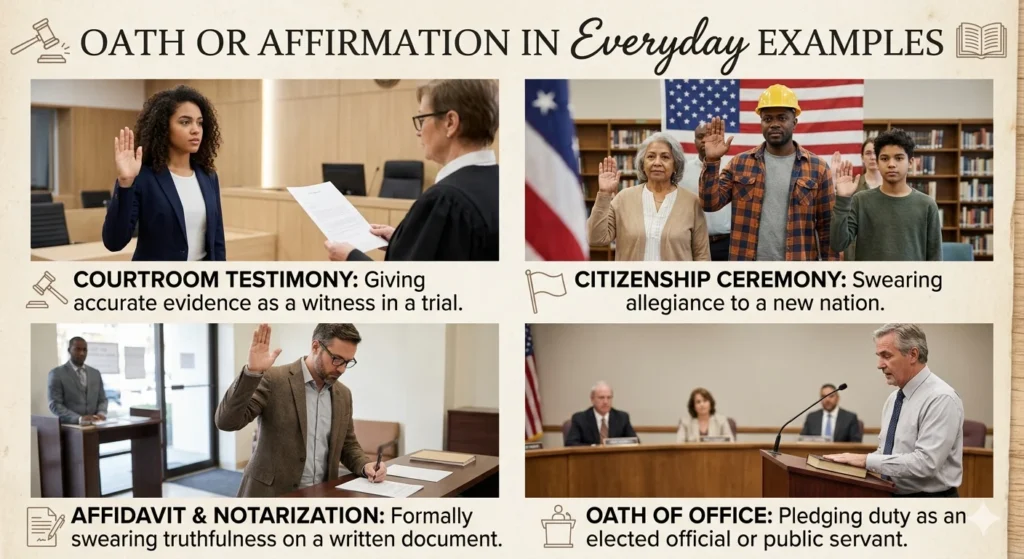
Oath or Affirmation in Everyday Examples
In Emails:
“Please complete the verification on oath or affirmation and return it by Friday.”
In News:
“The witness gave her oath or affirmation before testifying in the trial.”
In Social Media:
Posts often ask, “What are 5 good affirmations?” This refers to positive self-talk, not legal affirmations. Legal affirmations are different.
In Formal Writing:
“The applicant signed the verification upon oath or affirmation in the presence of a notary public.”
In Court:
The judge asks, “Do you swear or affirm?” You answer, then speak your truth.
In Notary Work:
A notary oath or affirmation is part of many notarial acts. The notary must ask which you prefer and then administer the correct one.
Oath or Affirmation Google Trends & Usage Data
Google search data shows that the phrase oath or affirmation is searched most in English-speaking countries. The United States has the highest volume, followed by the United Kingdom, Australia, and Canada.
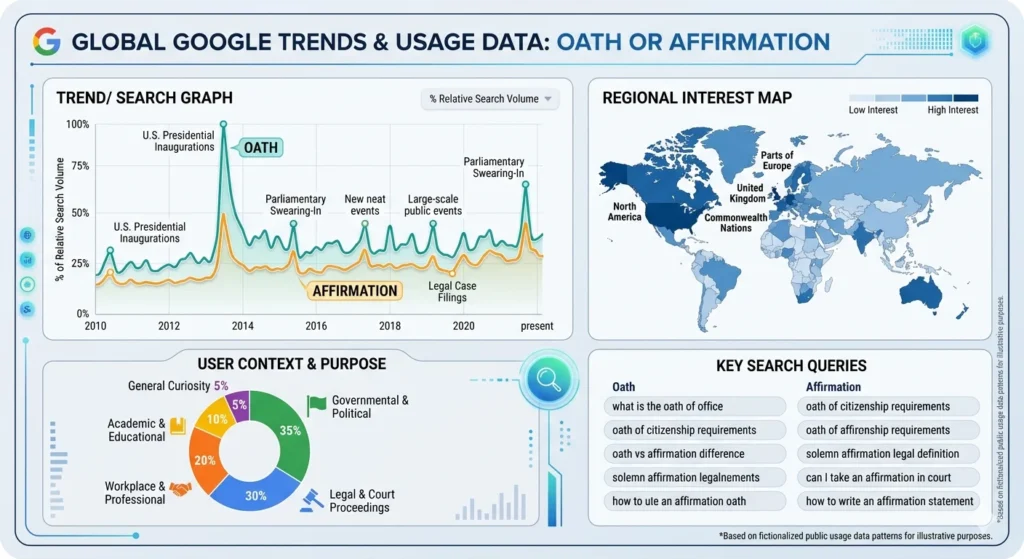
Context of searches:
- What does oath or affirmation mean in the fourth amendment? This is a common legal search. The Fourth Amendment protects against unreasonable searches and requires warrants to be supported by oath or affirmation.
- Oath or affirmation notary: Many searches come from people needing notary services.
- Difference between oath and affirmation in Parliament: This is popular in the UK and Commonwealth nations during election years.
- Oath or affirmation of citizenship form: Searches spike around naturalization ceremonies.
Interest remains steady year-round, with small spikes in January (new legislative sessions) and summer (naturalization ceremonies).
Comparison Table: Oath vs Affirmation
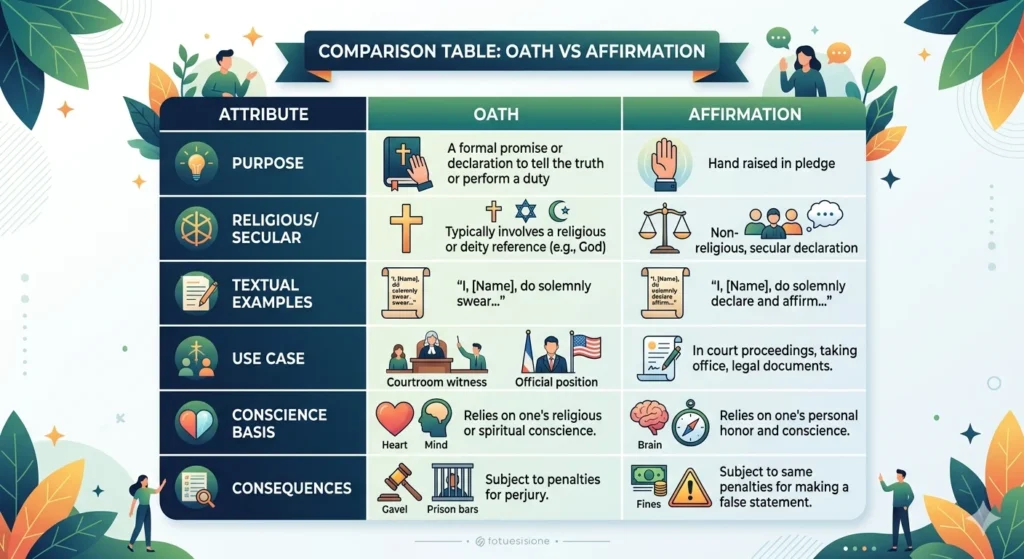
| Feature | Oath | Affirmation |
|---|---|---|
| Religious Reference | Yes (God or deity) | No |
| Legal Effect | Same as affirmation | Same as oath |
| Who Uses It | Religious individuals | Non-religious individuals, Quakers, atheists |
| Common Phrase | “I swear…” | “I affirm…” |
| Form Wording | “Oath” | “Affirmation” |
| Notary Requirement | Must be administered | Must be administered |
| Penalty for Lying | Perjury | Perjury |
FAQs
1. What are 5 good affirmations?
Positive affirmations are different from legal affirmations. Five good positive affirmations are: “I am capable,” “I am worthy,” “I choose peace,” “I grow every day,” and “I trust myself.” Legal affirmations are formal promises used in court or documents.
2. Where can I find the oath or affirmation of citizenship form email?
You can find this form through the USCIS website (in the US) or your country’s immigration office. They usually email you a link to download the form. Do not accept forms from unofficial sources.
3. Is it better to swear or affirm?
Neither is better. Choose based on your personal beliefs. If you believe in God and want to swear, take an oath. If you prefer not to involve religion, affirm. Both are equal in law.
4. What does “oath” mean?
An oath is a solemn promise, often made before God, to tell the truth or fulfill a duty. Breaking an oath can result in legal penalties like perjury.
5. What is oath or affirmation wording?
Oath wording: “I swear by Almighty God that the evidence I shall give shall be the truth, the whole truth, and nothing but the truth.”
Affirmation wording: “I solemnly and sincerely affirm that the evidence I shall give shall be the truth, the whole truth, and nothing but the truth.”
6. What is the difference between oath and affirmation in Parliament?
In Parliament, members may swear an oath on a holy book or make a non-religious affirmation. Both allow them to take their seat and vote. The choice is a matter of personal conscience.
7. Whose responsibility is it to ensure the oath or affirmation is taken correctly?
The official administering the oath or affirmation (judge, notary, clerk) must ensure it is done correctly. However, the person making the oath or affirmation must listen carefully and respond properly.
8. What does supported by oath or affirmation mean?
This phrase means a statement or claim is backed by a sworn promise. For example, a warrant must be supported by oath or affirmation, meaning a police officer swears under oath that the facts in the warrant are true.
9. What is a verification on oath or affirmation?
A verification on oath or affirmation is a sworn statement signed before a notary. It confirms that the information in a document is true. The notary administers the oath or affirmation and signs the certificate.
10. Can a notary administer an oath or affirmation to themselves?
No. A notary must administer an oath or affirmation to another person. A notary cannot notarize their own signature or swear to their own document.
Conclusion
Understanding the oath or affirmation choice is simpler than it seems. An oath involves a religious promise. An affirmation is a solemn promise without religion. Both are legally equal. Your choice depends on your personal beliefs.
When you see the phrase on a form, in court, or in a notary setting, remember: you have a right to choose. Whether you are dealing with oath or affirmation notary services, a jury oath or affirmation, or a verification upon oath or affirmation, the process is straightforward. Listen to the official, answer clearly, and sign where required.
If you are preparing for citizenship, look for the oath or affirmation of citizenship form email from official sources. If you are in Australia, search for oath or affirmation qld or oath or affirmation nsw based on your state. In the US, federal forms use the phrase supported by oath or affirmation frequently.
Now you know the difference. You can choose with confidence. And you can explain it to others simply.

“John Galsworthy was a refined storyteller known for expressive, emotional writing. At Wishveb.com, he brings graceful, heartfelt wishes to readers.”