Do you find yourself lying awake at night, trying to remember if a tense moment is nerve racking or wracking? You are not alone.
This is one of the most common spelling dilemmas in the English language. People search for this keyword because they are in the middle of writing an email, a social media post, or even a formal report and suddenly hit a wall of confusion.
The problem is that both spellings look correct, and both are often accepted, which only adds to the frustration.
The core confusion stems from the fact that racking or wracking are homophones (words that sound the same) with overlapping meanings related to pain, pressure, and destruction. This article solves that confusion once and for all.
We will explore the violent origins of these words, look at how they are used in different English-speaking countries, and give you clear, simple rules so you never have to wonder is it racking or wracking my brain again.
By the end, you will confidently know the difference between torturing a thought and wrecking a sentence.
Racking or Wracking means
If you need an answer right now, here is the simple breakdown: “Racking” is usually the safer, more traditional choice for formal writing.
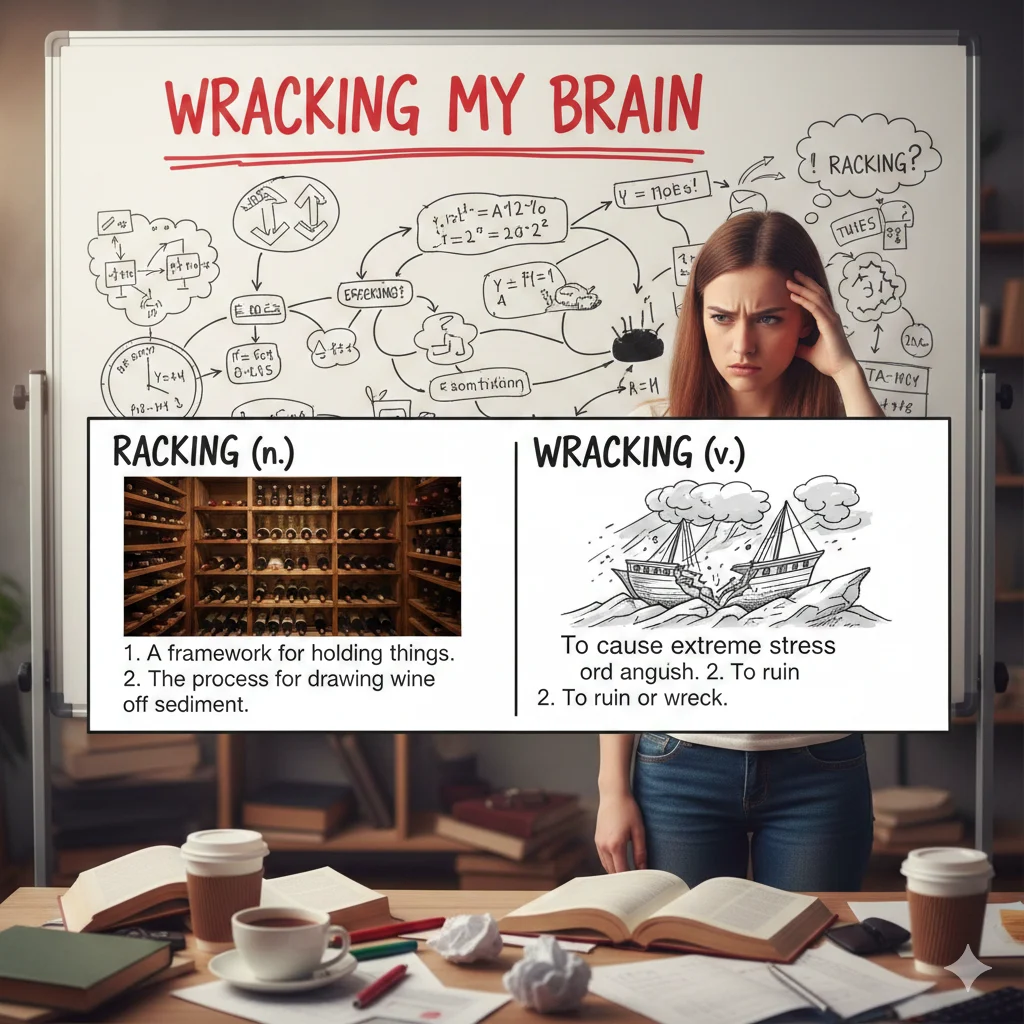
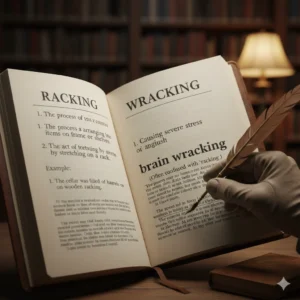
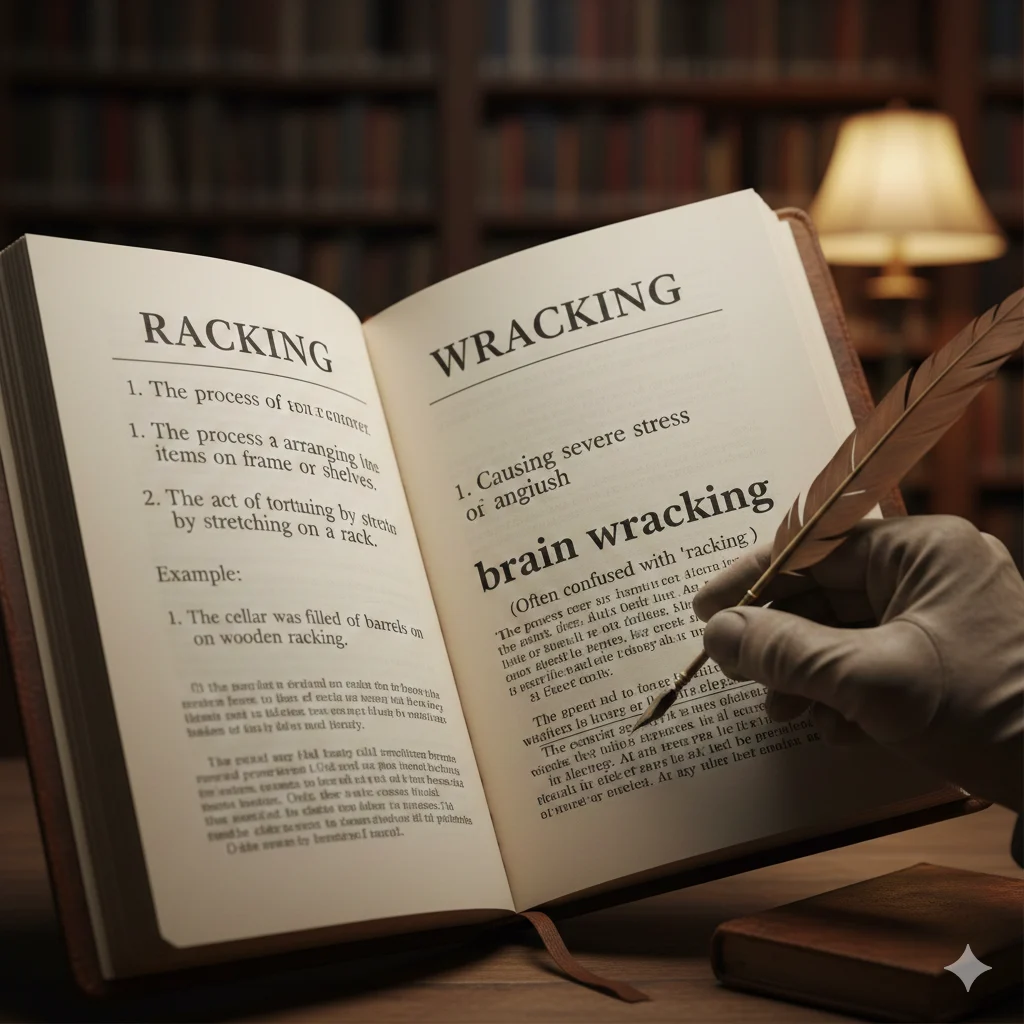
- Racking refers to stretching or torment. Think of the medieval torture device, the rack.
- Wracking refers to wrecking or ruining.
However, because language evolves, they are often used interchangeably today. Here is how they apply to common phrases:
- Is it racking up or wracking up debt? The standard spelling is racking up debt (accumulating).
- Is the term nerve wracking or nerve-racking? The original and most widely accepted spelling is nerve-racking.
- Is it racking or wracking your body? If you are in pain, your body is racked with pain (tortured by it) .
The Origin of Racking or Wracking
To understand why we have two words for what feels like the same thing, we have to look at history. The word rack comes from a Middle Dutch word rec, meaning to stretch . Historically, the rack was a torture device used to stretch a person’s body until their joints dislocated. This is why we use it to describe mental strain—you are stretching your brain to its limit.
On the other hand, wrack comes from Old English and is related to the words “wreak” and “wreck”. It has always been associated with destruction and ruin, often seen in the phrase “wrack and ruin” (though even that is now commonly spelled “rack and ruin”).
The spelling differences exist because for centuries, the pronunciation of “wr” words was tricky. As early as the 18th century, the ‘w’ in words like “wrack” became silent, making it sound exactly like “rack”. Once they sounded the same, people started mixing them up in writing, and over time, both became acceptable in many contexts.
British English vs American English Spelling
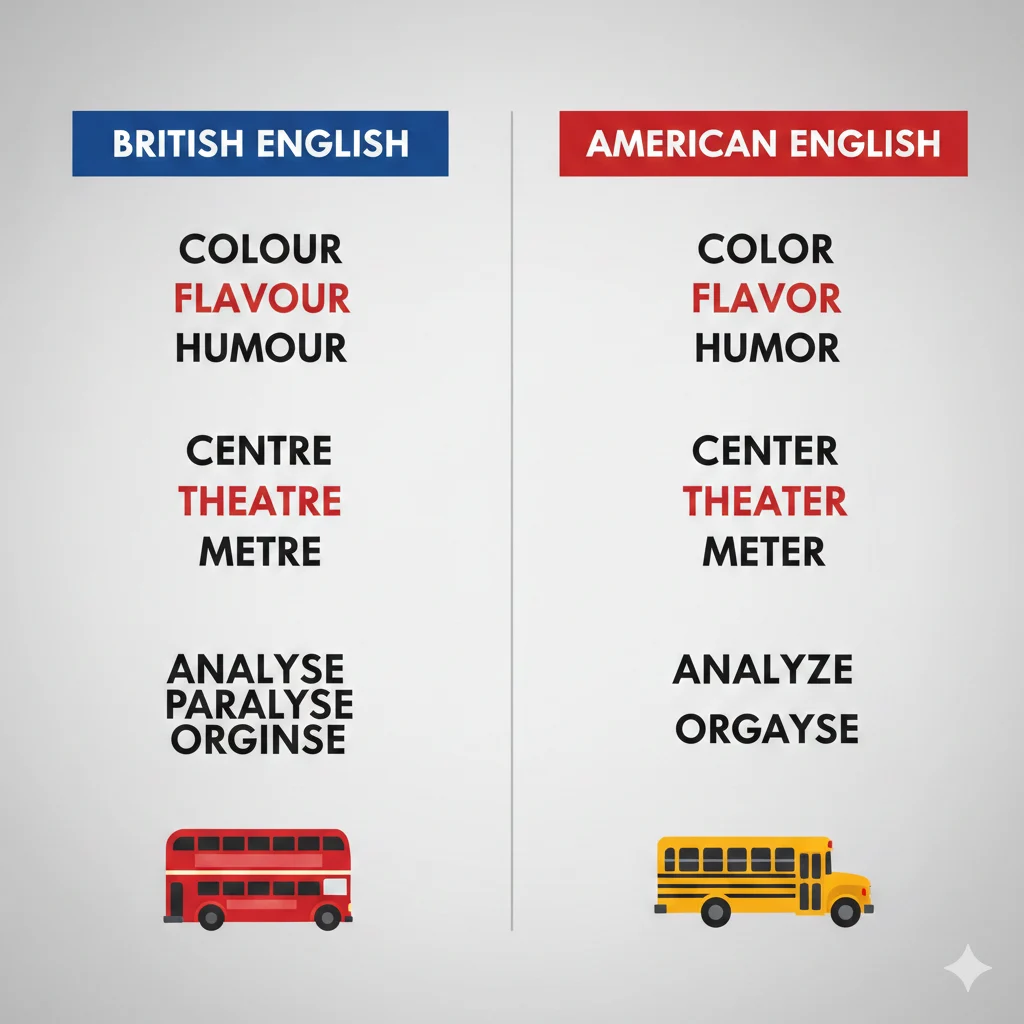
While the confusion exists on both sides of the Atlantic, there are slight preferences in usage. Generally, American English leans toward “racking” because it is more direct and relates to the physical device (the rack). British English is often more tolerant of “wracking,” perhaps due to its closer ties to the older, Germanic roots of the word.
Here is a comparison table to show how the common phrases usually break down by region and standard usage:
| Phrase | American English Preference | British/Commonwealth Preference | Notes |
|---|---|---|---|
| Nerve- | Racking | Wracking | “Nerve-racking” is the historical standard. |
| My Brain | Racking | Racking / Wracking | “Racking” is more common, but both are used . |
| Up (Debts/Points) | Racking | Racking | Almost always “rack up.” “Wrack up” is very rare . |
| With Pain | Racked | Racked / Wracked | Both are used to describe being tormented. |
| And Ruin | Rack | Wrack | The phrase originated as “wrack,” but “rack” is standard now . |
Which Spelling Should You Use?
Choosing between racking or wracking depends on your audience and the tone of your writing.

- For a US Audience (or Formal Writing): Stick with Rack. If you are writing a business report, a school essay, or a news article for an American publication, use “nerve-racking” and “racking my brain.” It is considered the standard and more professional choice .
- For a UK / Commonwealth Audience: You have more flexibility. While “racking” is still correct, using “wracking my brain” or “nerve-wracking” will not raise eyebrows. It is widely accepted in British English.
- For Global / Informal Writing (Social Media, Texts): Use whichever feels right. On Reddit, you will see users debating racking or wracking reddit constantly, and both appear. Since the meaning is understood, the spelling matters less in casual conversation.
Common Mistakes with Racking or Wracking
Even native speakers make mistakes with these words. Here are the most frequent errors and how to avoid them.
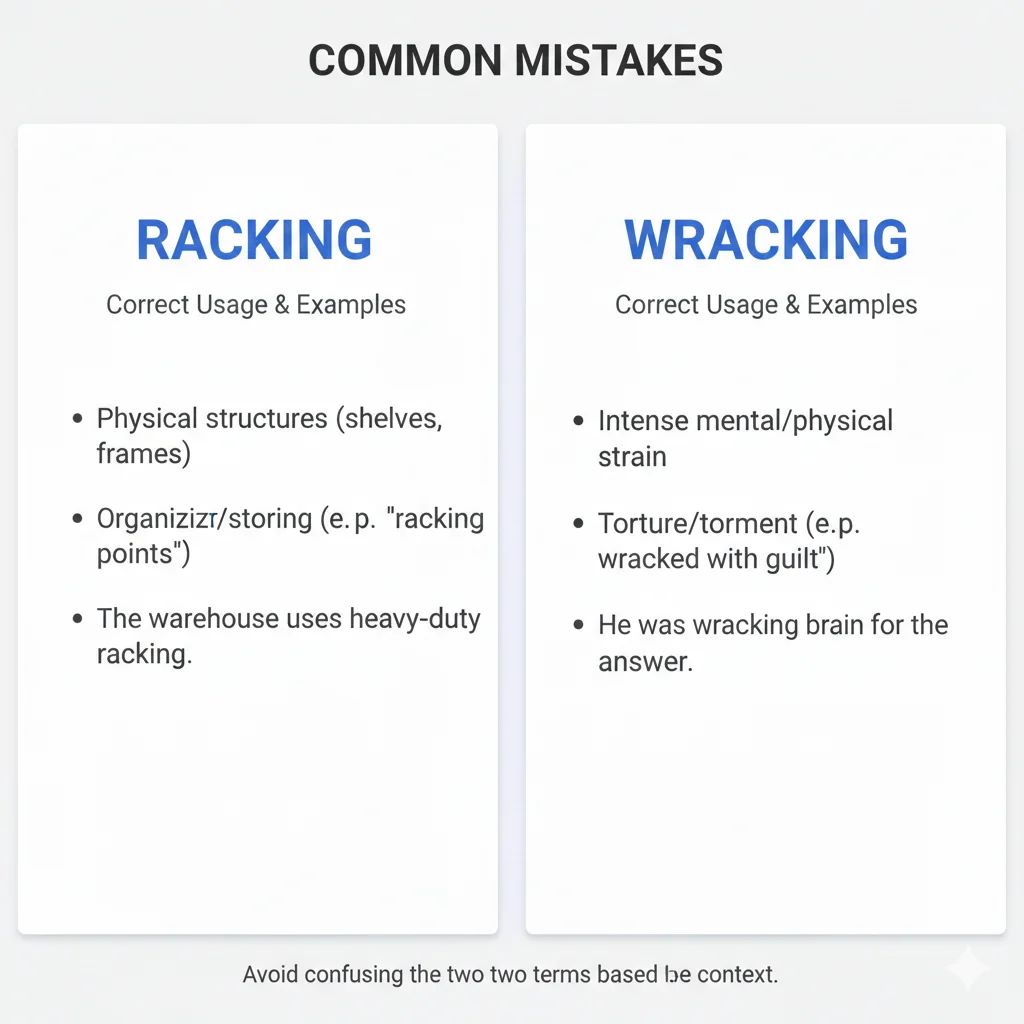
- Nerve-Wrecking: This is a common hyper-correction. People know “wrack” relates to wreck, so they add the ‘e.’ However, nerve-wrecking is non-standard and should be avoided . The correct choices are either nerve-racking or nerve-wracking.
- Wracking up: You might see this in informal comments, but racking up is the only standard spelling for accumulating things like points, miles, or debt.
- Using “Wrack” for Physical Torture: If you are describing physical pain (like a body in agony), “racked” is more powerful because it directly references the torture device. “He was racked with guilt” implies he is being stretched on a rack of guilt. “Wracked” implies he is destroyed by it—both work, but “racked” is more precise.
Racking or Wracking in Everyday Examples
Seeing these words in context helps solidify the difference. Here is how they appear in various types of writing.
- In Emails: “I have been racking my brain all week to come up with a solution for the client’s problem.”
- In News Headlines: “The team is racking up points as they head into the playoffs.”
- On Social Media (Twitter/Facebook): “Waiting for the doctor’s call is absolutely nerve-wracking! Wish me luck.”
- In Formal Writing: “The country, racked by civil war, is struggling to rebuild its economy.”
- In Literature: “The old house, left to rack and ruin, stood as a monument to a forgotten family.”
Racking or Wracking – Google Trends & Usage Data
If you look at search data and usage trends, “racking” is the clear winner in terms of frequency. As one informal poll noted, searches for “racking my brain” significantly outnumber “wracking my brain” . However, “nerve-wracking” holds its own and is searched almost as frequently as “nerve-racking.”
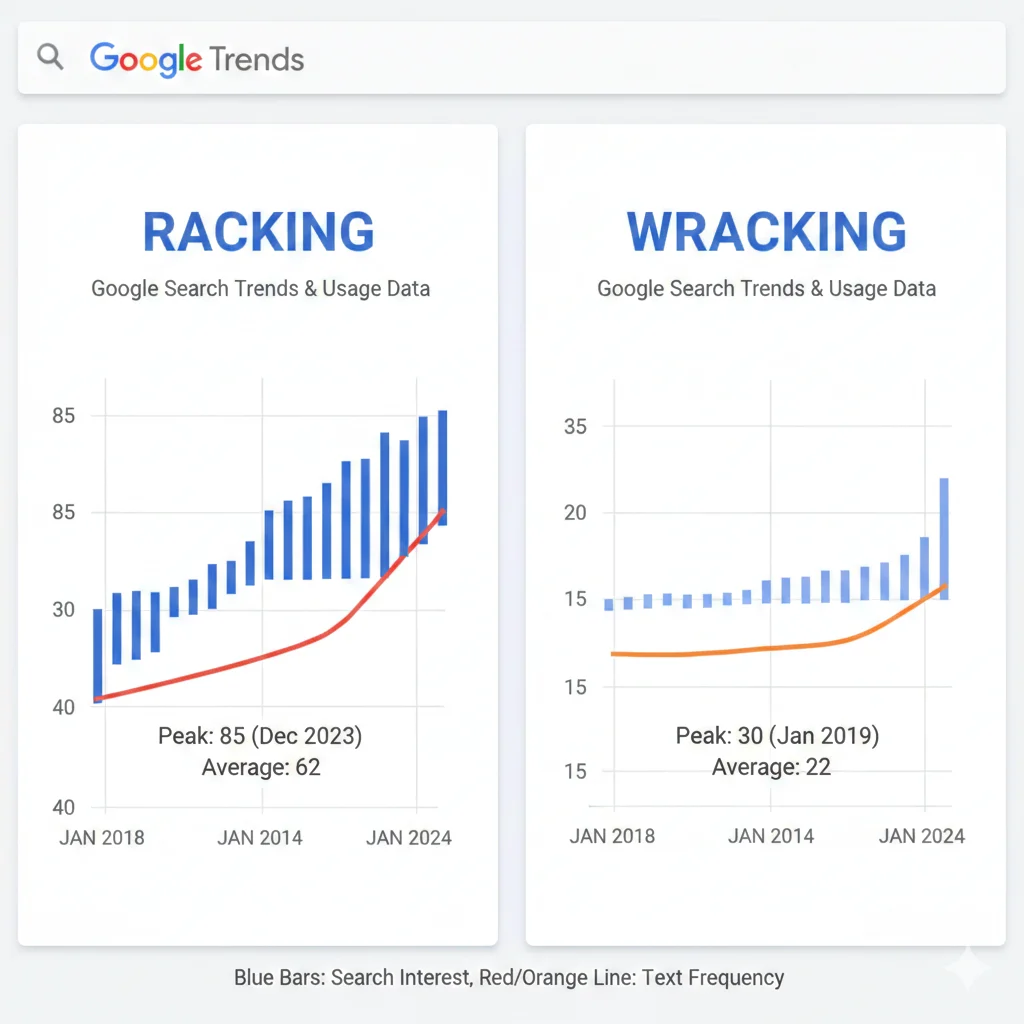
In countries like the United States and Canada, data suggests a strong preference for the ‘rack’ spelling. In the UK, Australia, and New Zealand, the ‘wrack’ spelling appears more frequently in blogs and informal publications. Essentially, if you want to play it safe globally, “racking” is your best bet.
FAQs
1. Is it nerve racking or wracking?
Both are acceptable, but nerve-racking is the original and most common spelling in dictionaries.
2. Is it racking or wracking my brain?
You can use either, but racking my brain is more traditional. It refers to the idea of stretching your mind, like on a torture rack.
3. What does “wracking” mean?
Wracking generally means to wreck, ruin, or cause destruction. It is often used to describe severe pain or distress, as in “wracked with sobs”.
4. Is it racking up or wracking up debt?
The correct phrase is racking up debt. This comes from the verb “rack,” meaning to accumulate, like in pool when you rack up the balls.
5. Why do people spell it “nerve-wracking”?
People spell it “nerve-wracking” because they associate the feeling with being “wrecked” or destroyed by anxiety. The word “wrack” is a variant that means wreck, so the connection is logical even if it isn’t the original spelling .
6. Can I use “wracking” in formal writing?
It is safer to use “racking” in formal writing (especially in the US). However, in the UK, “wracking” is often accepted in formal contexts when used in phrases like “nerve-wracking.”
7. What does “wrack your brain” mean?
Wrack your brain means the same as “rack your brain”: to struggle very hard to remember or think of something .
Conclusion
So, is it racking or wracking your brain? By now, you know that while the words have different origins—one of torture and one of ruin—they have converged in modern English. The most important takeaway is that in 99% of cases, you will be understood regardless of which you choose. However, if you want to be precise, remember these simple rules: use racking for accumulation (racking up sales) and mental strain (racking my brain), and use nerve-racking when you want to follow standard dictionary preferences.
Don’t let this common spelling dilemma wrack your nerves any longer. Whether you choose the traditional path of “racking” or the descriptive path of “wracking,” write with confidence knowing that the evolution of language is on your side.