Have you ever found yourself pausing mid-sentence, wondering if you should use “tacit” or “tacet”? You are not alone.
Many people search for tacet or tacit because these two words sound almost identical but carry very different meanings. This confusion is completely normal, as both words come from the same Latin root, tacere, meaning “to be silent.”
However, mixing them up can change your sentence from describing a silent agreement to instructing a musician to stop playing.
This article will clear up the confusion once and for all. We will explore what does tacit mean, explain the musical role of “tacet,” and give you the tools to use each word correctly.
By the end, you will confidently know the difference and never second-guess your choice again.
Tacet or Tacit maens
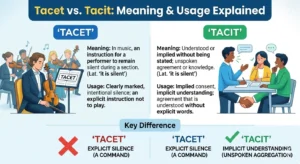
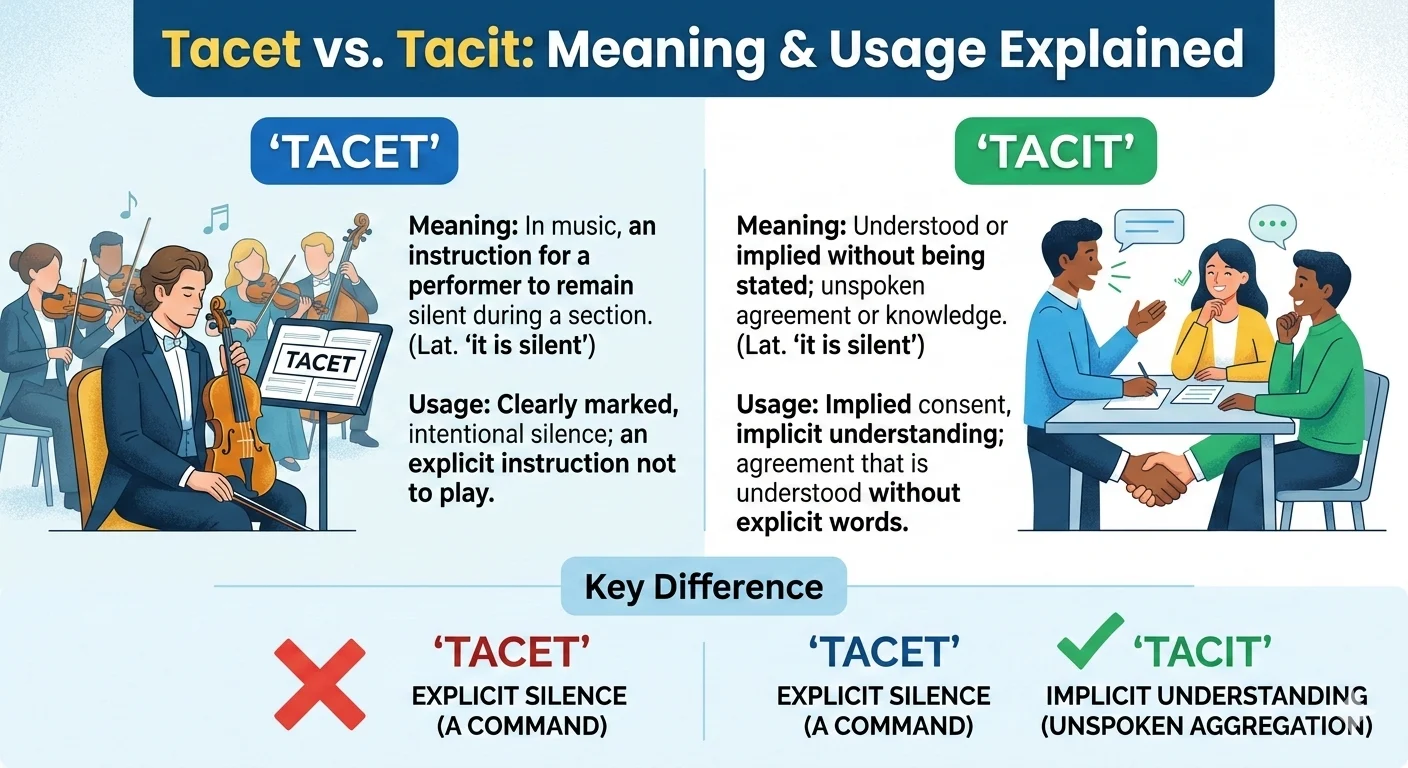
The quick answer is simple: use tacit for unspoken ideas and tacet for musical silence.
- Tacit is an adjective. It describes something that is understood or implied without being directly stated.
- Example: “She gave her tacit approval by simply nodding her head.”
- Tacet is a verb (or musical instruction). It indicates that an instrument or voice should be silent for an entire movement or section.
- Example: “The drummer’s part says ‘tacet‘ for the slow movement.”
If you are talking about an agreement, knowledge, or a feeling that is unspoken, the word you want is tacit. If you are reading a piece of sheet music and see an instruction for an instrument to stop playing, it is tacet .
The Origin of Tacet or Tacit
The confusion between these two words exists because they are closely related siblings, not rivals. Both were born from the same Latin parent: the verb tacēre, which means “to be silent” .
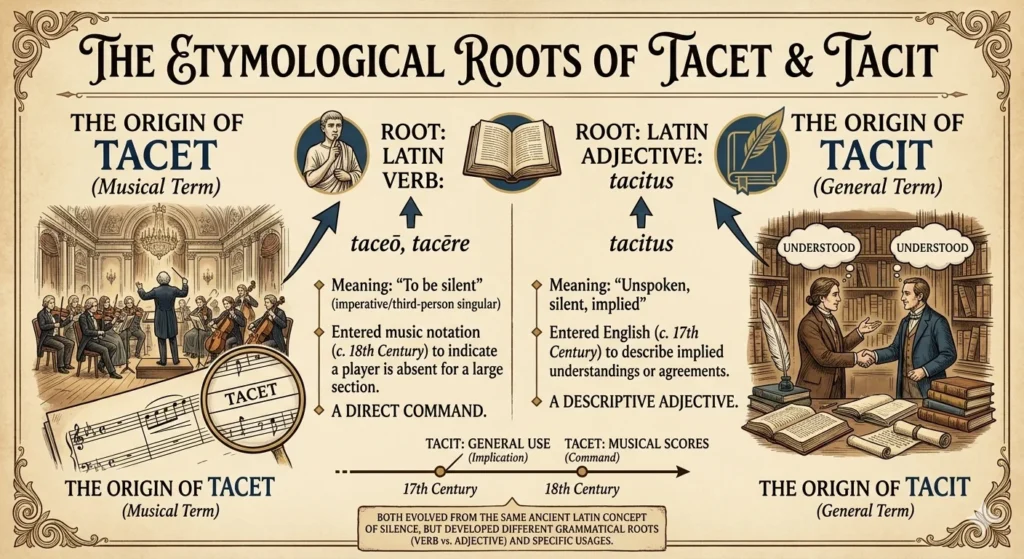
- Tacit came into English first, around 1576. It was adopted from the Latin word tacitus, which means “silent” or “done without words.” It kept its meaning as a descriptive word for things that are not expressed aloud .
- Tacet arrived in English much later, around 1724. It was taken directly from the Latin phrase tacet, which literally means “it is silent.” It was imported as a technical term for musicians and has stayed in that specific lane ever since .
So, while they share a family history, they grew up to have very different jobs in the English language. One describes the world around us, and the other gives orders on a musical score.
British English vs American English Spelling
When it comes to the spelling of “tacit” versus “tacet,” there is no difference between British and American English. The spelling of each word is fixed. However, the confusion often arises from pronunciation.
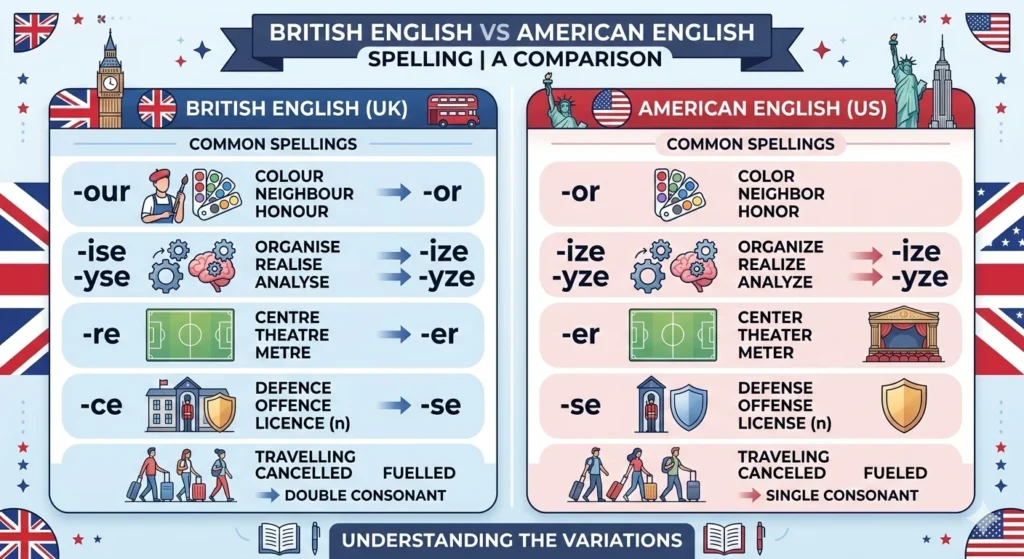
While spelling is the same in both dialects, there are very slight pronunciation tendencies. Both pronounce tacit with a soft “c,” sounding like “tass-it” . Tacet is generally pronounced “tay-set” or “tah-set” in both US and UK English, closely mirroring its original Latin pronunciation .
Here is a quick comparison to show the difference at a glance:
Which Spelling Should You Use?
Your choice depends entirely on your audience and subject matter. Using the wrong word can confuse your reader or make you sound inexperienced.
- For a US Audience: The word you will use 99% of the time is tacit. It is a standard English word used in newspapers, books, and everyday conversation. Tacet is a niche musical term and will only be understood in that specific context.
- For a UK / Commonwealth Audience: The same rule applies. Tacit is the common adjective for unspoken matters. Tacet is still only used in music.
- For a Global or Specialized Audience:
Common Mistakes with Tacet or Tacit
The most frequent error is using these two words interchangeably. Here is how to spot and fix the most common mistakes.
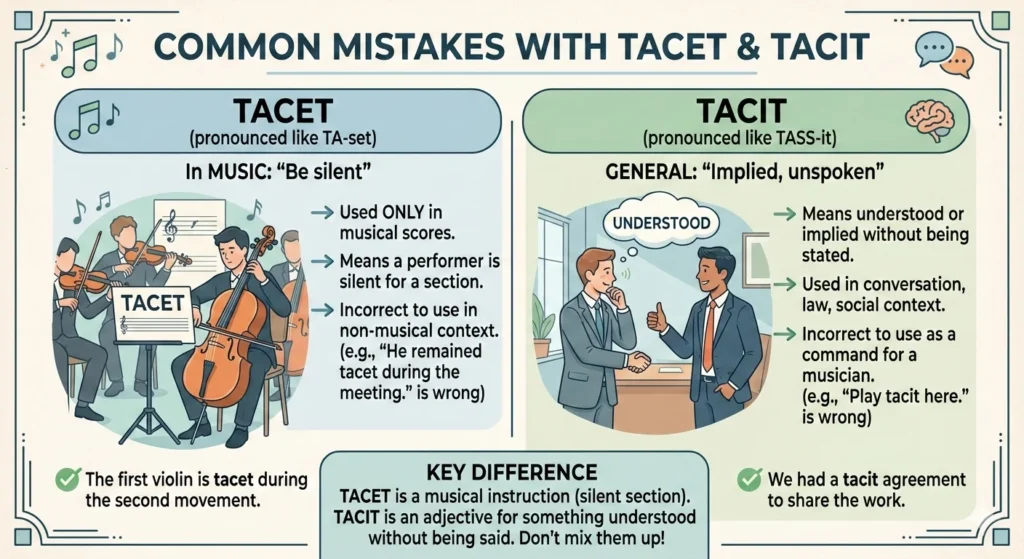
- Mistake: “We had a tacet agreement to meet for coffee every week.”
- Correction: “We had a tacit agreement…” (An agreement is an unspoken idea, not a musical rest).
- Mistake: “The conductor said the cellos should be tacit for this part.”
- Correction: “The conductor said the cellos should be tacet…” (This is a direct instruction on a score).
- Mistake: “He gave his tacet approval with a smile.”
- Correction: “He gave his tacit approval…” (Approval is a concept, not a musical direction).
Another point of confusion is the phrase tacit knowledge meaning. This is a specific term for knowledge that you have but is difficult to write down or explain to someone else, like knowing how to ride a bike . Remember, it’s always “tacit knowledge,” never “tacet knowledge.”
Tacet or Tacit in Everyday Examples
Seeing these words used correctly in context is the best way to learn. Notice how tacit fits into regular language, while tacet lives in the world of music.
- In a business email: “By not objecting to the plan, the director gave her tacit approval to move forward.”
- In a news article: “The prime minister’s visit was seen as a tacit endorsement of the candidate.”
- On social media: “We had a tacit understanding that we wouldn’t talk about politics at dinner. It kept the peace.”
- In formal writing: “The philosopher Michael Polanyi is famous for exploring the concept of tacit knowledge” .
- In a music score: You might see “Flute tacet” written at the beginning of a new movement, meaning the flutist should be silent until it’s over .
- In a music lesson: A teacher might explain, “Is it tacit or tacet in music? It’s tacet, and it tells you to stop playing.”
Tacet or Tacit – Google Trends & Usage Data
If you look at word usage data, the difference in popularity is staggering. Tacit is a commonly used word in the English language, appearing in everything from academic journals to magazine articles . Tacet is a very low-frequency word that appears almost exclusively in discussions about music.
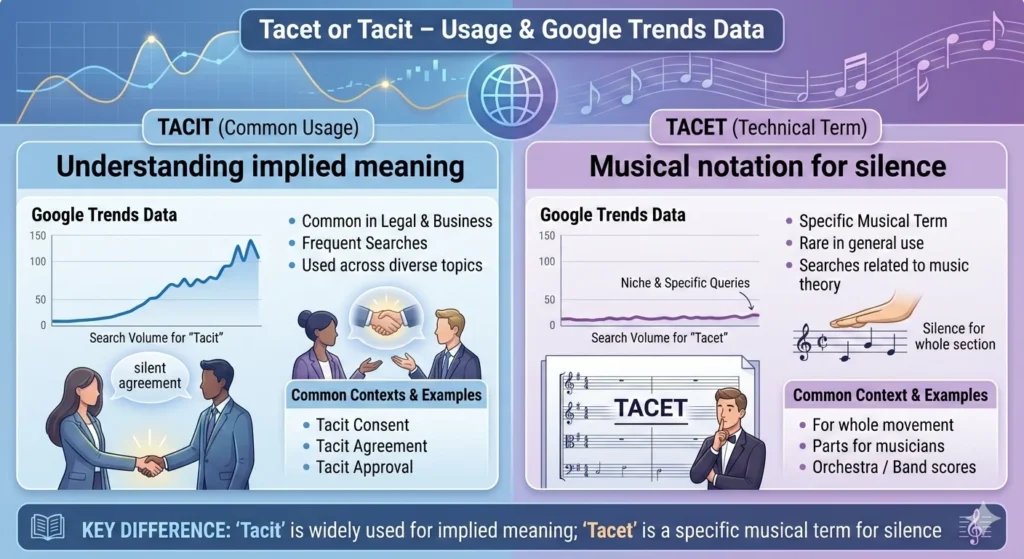
- By Country: English-speaking countries like the US, UK, Canada, and Australia all search for “tacit” far more often than “tacet.” The searches for “tacet” are usually from musicians or students looking up what is the meaning of tacet in English.
- By Context: The word “tacit” is used broadly. The word “tacet” is used specifically. A search for tacit or tacit in english will almost always be about the spelling or meaning of “tacit,” as “tacet” is rarely used in general English text.
Frequently Asked Questions (FAQs)
1. What does tacit mean?
Tacit means something is understood or implied without being directly stated in words. For example, if your friend hands you a tool while you are fixing a bike, it is tacit permission to use it .
2. Is it tacit or tacet?
It depends on what you want to say. If you mean an unspoken agreement or idea, use tacit. If you are referring to a musical instruction to be silent, use tacet .
3. What is the meaning of tacet in English?
In English, tacet is a musical direction from Latin meaning “it is silent.” It instructs a musician not to play for an entire movement or section of a piece .
4. Is it tacit or tacet in music?
In music, the correct term is tacet. You will see it on sheet music to indicate that a specific instrument does not play during a part .
5. What is a good tacit synonym?
Good synonyms for tacit include: implicit, unspoken, unexpressed, silent, and understood .
6. How do you use tacit in a sentence?
Here is an example of tacit in a sentence: “Their friendship was based on a tacit trust that neither would betray the other’s secrets.”
7. What is tacit knowledge meaning?
Tacit knowledge refers to the skills, ideas, and experiences that people have but find very difficult to explain or write down. Knowing how to speak your native language or ride a bicycle are examples of tacit knowledge .
8. How do you pronounce tacit?
Tacit pronunciation is simple: it rhymes with “pass it.” In both US and UK English, it is pronounced TASS-it .
Conclusion
In the battle of tacet or tacit, there is no winner—only two distinct words with separate jobs. The key takeaway is to remember their core functions. Tacit is your go-to adjective for describing anything that is silently understood, from agreements to knowledge . It is a common word you will use in writing and conversation. Tacet, on the other hand, is a specialized musical term that tells a performer when to stay silent . You will likely only encounter it on a musical score.
By understanding their origins and specific meanings, you can confidently choose the correct word every time. So, the next time you are describing an unspoken rule at work, you will know it’s a tacit agreement. And if you ever pick up a piece of sheet music, you will be glad to know exactly what to do when you see the word tacet. Keep this simple guide in mind, and you will master these two tricky terms for good.

“John Galsworthy was a refined storyteller known for expressive, emotional writing. At Wishveb.com, he brings graceful, heartfelt wishes to readers.”